

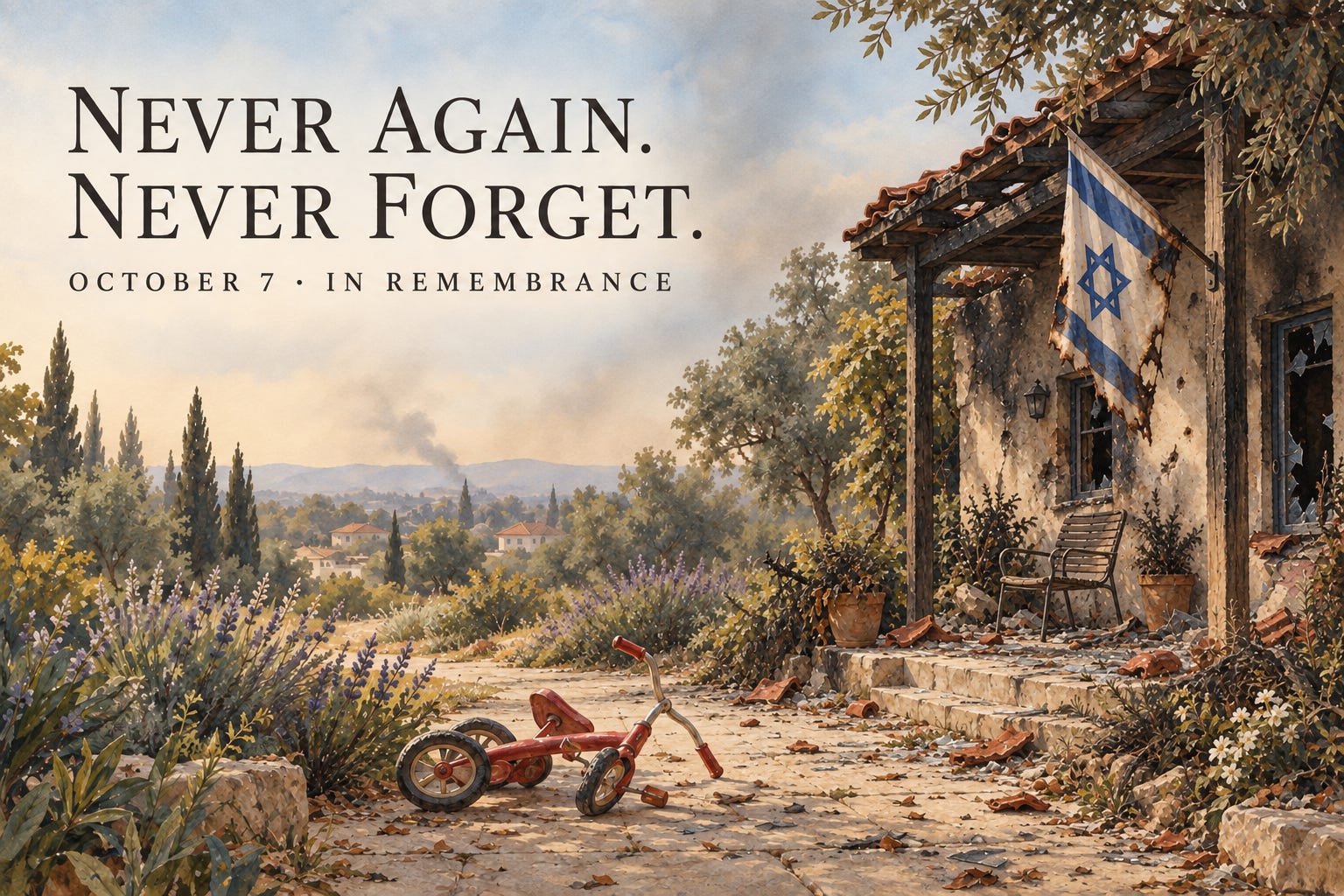
Much of my work centres on October 7. In a way I see that work as a way to honour the fallen: to examine the catastrophic mistakes that left them defenceless in the face of pure evil and examine what Israel must do differently to ensure such a day would never happen again.
But today, I would rather not write another philosophical analysis. Today, I want to remember the victims.
The 1,163 elderly people, women, children, and men. People whose lives were taken with incomprehensible brutality. Even with all the footage and everything we have learned since that terrible day, we cannot truly grasp what they endured.
I am heartbroken by this. I always will be. I want to honour and remember those who were killed, those who were injured, and those who survived that horrific experience and still carry it with them.
For the past two anniversaries of October 7, I have shared stories and written about the meaning of memory. In the first year, I wrote about Romy, the little girl who asked whether the people who came to save her were from Israel. Last year, I wrote about the great hero Aner Shapira.
This year, I am a little lost for words.
My words feel pale beside the simplest words spoken on that day. A father telling his daughter that he loves her. A daughter telling him that her murderers are coming. Then no reply.
Today, I read an exchange of messages shared on Instagram between a young woman at Nova and her father. I am still carrying it with me. What struck me was the familiar WhatsApp screen. The same screen on which we arrange dinner, ask whether someone has arrived home, and tell someone we love them. A father worrying about his daughter. A daughter terrified. And then the messages stop.
I can take all the time I need to choose my words. They had no such time. I do not know how anything I write could carry their word’s weight.
I also think about the thirteen people murdered in their minibus in Sderot. They had set out for a day at the Dead Sea. A flat tyre interrupted their journey. Hamas terrorists found them stranded and shot them at close range. Older people setting out for a day of rest and enjoyment. It is almost unbearable to think how little stood between that ordinary morning and the end of their lives. The grotesque absurdity is unbearable.

We hear too little about them. It is impossible to remember every story, but I do not want these thirteen people to be reduced to a number. Their remaining years was theirs. Their families were waiting for them to come home. Why were they not allowed to return?
One of them was Zena Bailin, sixty years old. Her mother, Galina, had survived the Holocaust as a child. That morning, Zena had driven her mother home before leaving for the trip. Later, Galina called her daughter. There was no answer.
Galina remembered how her own mother had protected her during the Holocaust. Now she felt guilty that she had not been able to protect Zena. A woman who had survived Nazi persecution lived to see Hamas take her daughter in the country that was founded in the name of ‘never again’. I cannot find words equal to that grief. I can only refuse to let it become ordinary.
They were real people. Not symbols. Not an argument. People with thoughts, feelings, values, relationships, and plans. People who wanted to live. Their lives were taken from them with vicious savagery, while the country that should have protected them was criminally absent.
October 7 changed me. I carry that day even when I am far from home. I am in Europe now, but distance does not put it behind me. Neither does time.
Yet time does something else. It makes the unbearable familiar. We hear another story, see another video, and encounter another defence of the indefensible. We become exhausted. And we begin to expect it.
Hundreds of thousands around the world dare to celebrate this day. Even celebrations of that day can become something we expect, rather than something we refuse to accommodate. Another slogan. Another public gathering. Another provocation. As though celebrating the mass murder of Jews were an ordinary political position and not a profound moral disgrace.
What frightens me is not only that there are people who celebrate. It is that we can grow accustomed to their celebration. People can praise such acts and still be treated by the Western societies that host them as ordinary members of society, rather than as the monsters they are.
We are surrounded by images of death and savagery. But we must remember that repetition does not make them normal. Familiarity does not make them acceptable. Exhaustion does not make them right.
I will never forget October 7. I will never let it become an ordinary day. I will not accept celebrating its atrocities as a legitimate political position. I will stand against it as strongly as possible.
I will remember the victims and the heroes. I will remember their humanity and the inhumanity that faced them. I will remember that behind every name was a person with a life they wanted to go on living.
And remembrance must ask something of us. We must defeat those responsible for these atrocities and prevent them from committing more. We must demand a country capable of defending its people. We must refuse to let the failure to protect them become something we simply learn to live with.
We cannot undo what happened. But we must refuse to normalise it. We must refuse to make peace with the celebration of it. We must insist that remembering the dead includes the responsibility to protect the living.
Let us never forget them.
יהי זכרם ברוך
I will never be the same either. Mostly because of the sick, sadistic things that were done to those precious Israelis (and their guests), but also because of the sick, sadistic reaction around the world- including American college campuses. What an absolute horror. People died. Decency died. And a sense of safety died for all Jews around the world. My own friend and neighbor’s reaction was “well, there are issues on both sides”. I’ll never forget it. And I’ll never forgive it. Am Yisrael Chai.
https://music.apple.com/us/album/freedom-song-zahor-9-11/53431692?i=53431569