

It is a strange idea for a man who was born long after he died to write a tribute to him. But perhaps his life and work are exactly why it is appropriate. He dedicated himself to recordings, to the camera—to preserving music, teaching it, communicating it—and through that work made it possible for someone born many years after his death to feel as if he had known him all his life. Because, in a sense, he did—perhaps more intimately than he knows many people who are still alive.
Today is the birthday of one of the greatest musicians, artists, and communicators of the 20th century: Maestro Leonard Bernstein.
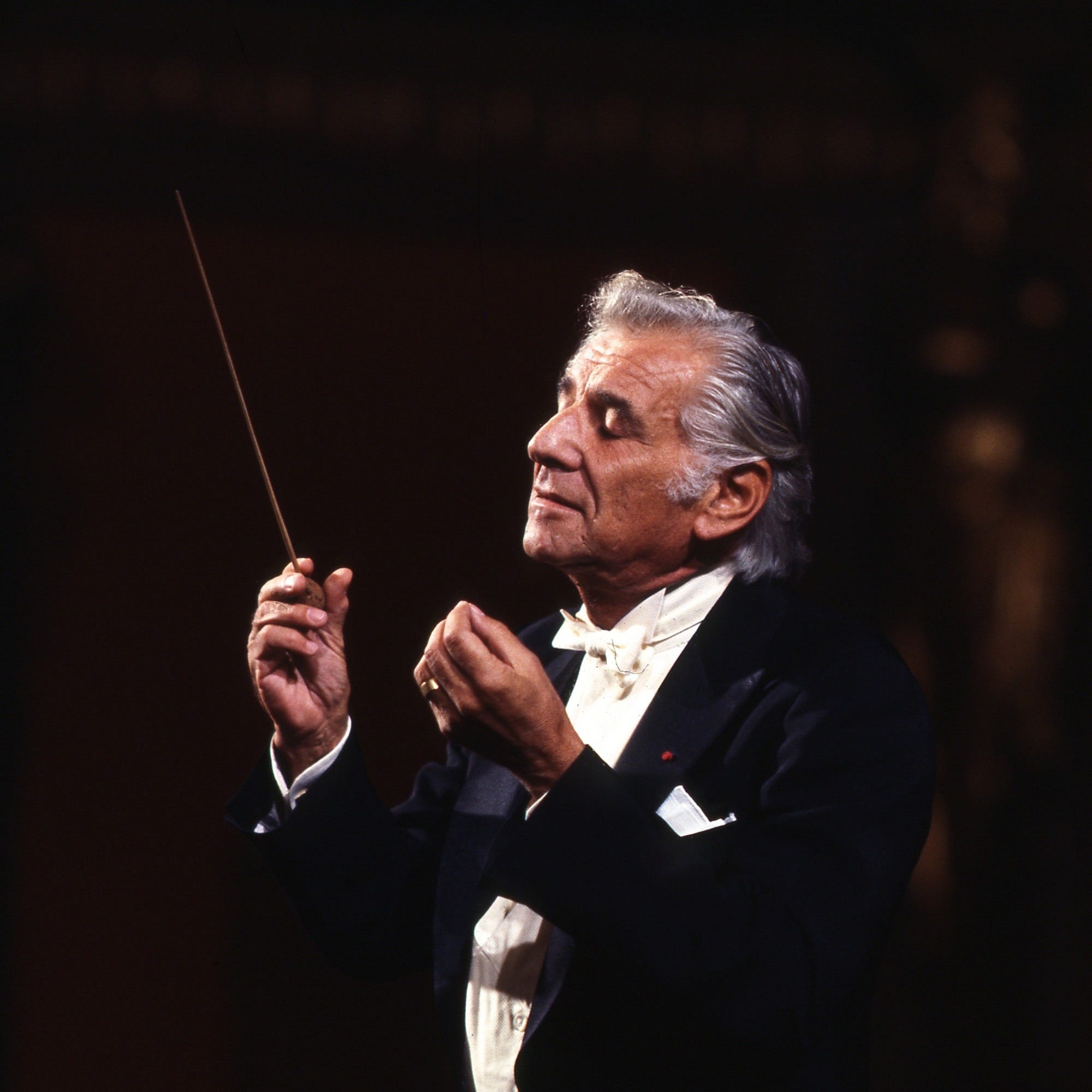
I have written before about the idea of the cultural hero. A cultural hero is not a celebrity, nor merely a skilled technician. He is someone who acts with conviction, who understands that his art isn’t neutral, that beauty isn’t leisure but a necessity for the human soul. There were several such figures in the 20th century. But perhaps no life embodied that idea more completely, more extravagantly, than Bernstein’s.
For him, music was inseparable from life.
In 1948, at twenty-nine years old, he flew to the newly born State of Israel in the middle of its War of Independence. He conducted forty concerts in sixty days across a country still fighting for its existence. Bombs and gunfire could be heard while he worked, and Bernstein later said how happy he was to be in Israel and to open the first season of the Philharmonic Orchestra in the Jewish State.
Then came Beersheba.
The city had only recently been liberated from the Egyptian army. Bernstein travelled there with members of the orchestra and performed before soldiers on a makeshift stage. He played not one but three piano concertos—Mozart, Beethoven and Gershwin.
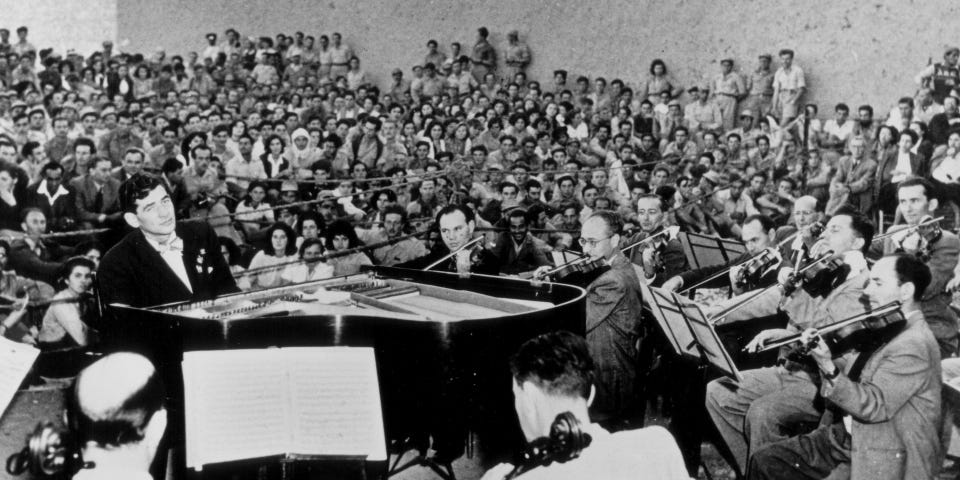
Who would take time in war to listen to Mozart?
That was precisely the point.
People who understood that beauty is not an ornament to survival, but its completion. Where death had sounded, life had to resound. Civilisation cannot be defended by weapons alone, because one must also know what the weapons are defending. We survive in order to live—to build, to love, to create, to listen to Beethoven, to be able to play Mozart in the desert while a war is raging around us.
And Bernstein returned. Again and again.
In 1967, after the Six-Day War, Bernstein returned to Jerusalem and stood on Mount Scopus to conduct Mahler’s Second Symphony—the Resurrection. The choice couldn’t have been more symbolic. For the first time in nearly two thousand years, Jerusalem—the capital of the ancient Jewish kingdoms, the city of the Temple, the city toward which Jews had prayed throughout centuries of exile—was again under independent Jewish rule, barely twenty-two years after the Holocaust. And Bernstein was not standing among ruins or monuments to an ancient past. He stood at the Hebrew University, on a campus from which Jews had been cut off for almost twenty years: a modern university, teaching and creating in a language that itself had been resurrected into everyday life. Below him stood ancient Jerusalem; around him, the intellectual life of the modern Jewish state. And there he raised his baton to conduct Mahler’s Resurrection.
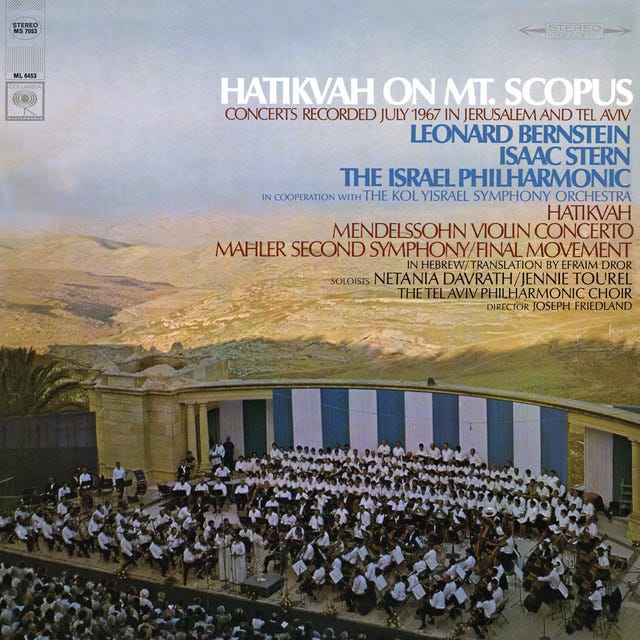
There is, remarkably, a film of this journey. A Journey to Jerusalem follows Bernstein and Isaac Stern through Jerusalem in the weeks after the Six-Day War, as they prepare for the Mount Scopus concert, and includes extraordinary footage of the concert itself. I cannot recommend it highly enough. It captures not only the historical moment, but Bernstein in the middle of it—talking to people, rehearsing, reacting, absorbing what had happened around him. Some of the exchanges caught by the camera are remarkable. If you want to understand the Bernstein I am writing about here, watch this film.
Beyond performing in monumental historic moment, Bernstein also spent his life trying to make the masses understand the music he championed. Watch him teaching children about Beethoven, giving his Harvard lectures, or rehearsing an orchestra—singing some ridiculous imitation of an instrumental line, waving his arms, laughing, sweating, arguing, pleading.
One crucial aspect of Bernstein’s life is that aside from the talented conductor that he was, he was an incredibly talented composer. There is one work I would particularly recommend listening to today: Halil. Bernstein wrote it in memory of Yadin Tenenbaum, a nineteen-year-old Israeli flutist killed during the Yom Kippur War. The work is concerned with war, the desire to live, and the consolations offered by art, love and hope. It is difficult for me to imagine a work that captures Bernstein better. Here is death and grief, answered by the sound of a flute.
Listen, if you can, to the recording with Jean-Pierre Rampal and the Israel Philharmonic Orchestra, conducted by Bernstein himself. There is something almost unbearably fitting about a work written in memory of a young musician who would never grow old, played by one of the great flutists of the century, with the Israel Philharmonic under Bernstein’s baton. Halil seems to contain, in miniature, much of what he believed music could do.
Leonard Bernstein died in 1990. I never saw him conduct or heard him speak in a hall. I never had the privilege of sitting in a rehearsal while he jumped, sang, shouted, laughed and somehow pulled music out of an orchestra. And yet I cannot quite say that I never knew him. He made sure of that.
Perhaps that is what it means, in the end, to be a cultural hero: not merely to shape one’s own time, but to remain capable of speaking to lives one could never have known. Bernstein is truly a man who lives in eternity. On August 25, 2118, when the world marks his 200th birthday, I will not be here. But somewhere, I imagine, some young person born generations after me will discover one of those recordings. Bernstein will turn towards the camera and begin to speak; his eyes will light up, and this young person will feel him just as close as I do now, as if he had known him all his life.
I will not be there. But Lenny certainly will.
If you enjoyed Philosophy: I Need It and want to see more, you can support my work by buying me a coffee or becoming a monthly supporter.
Every contribution makes a real difference. Thank you!
And if you’re looking for something longer, my debut novella, The Weight of Silence, is available on Amazon. Get your copy here.
Luckily, someone had the sheer brilliance to show the Mount Scopus concert on a pretty recent Independence Day. Not that I don't enjoy the Bible quiz, but wow. I loved seeing his excitement, his thrill to throw in a few Hebrew words, maybe even a bissel Yiddish. But also, how quaint the optimism now sounds to my jaded ears.
Just forwarded this piece on to my father-in-law, who used to attend his Young People's Concerts.