

I. The Wine House
The wind along the riverfront had a way of cutting through the coat, but I was warm enough, still satisfied with the herring sandwich I had just eaten. I wandered toward the old city centre, letting the streets pull me inward, when a small plaque caught my eye.
Historic Wine House.
“For more than three hundred years,” it read, “wine has been traded in this merchant building in Lübeck. A large range of wines from various regions of Germany, Europe, and overseas can be found here, including the famous Lübecker Rotspon.”
Curious, I stepped inside.
A tall old German man in a hat greeted me with a wide, easy smile and asked whether I was looking for something specific. The shop opened into aisles filled with bottles from France, Italy, and across Germany. I looked around for the name I had just read outside, the Rotspon, wondering quietly where exactly wine could be made in Lübeck. The climate did not strike me as particularly friendly to vineyards.
I asked him about it.
“Of course,” he said, pointing toward the cashier. “By the teller.”
There stood an array of deep red bottles labelled Lübecker Rotspon. I asked again, half amused, where the vineyard was.
“There isn’t one,” he explained. The wine came from Bordeaux and was brought north; it undergoes its own ageing process at Lübeck, deepening in colour and richness. The result is something distinct, neither entirely French nor entirely local, a wine created by the journey itself.
I asked for a bottle.
Only then did I notice, beside the cashier, an old oval plaque bearing the emblems of cities: Hamburg, Mecklenburg, Schleswig, England, Denmark, Prussia and Lübeck itself. Some names familiar, others belong more to history than to present maps. I found myself staring at it.
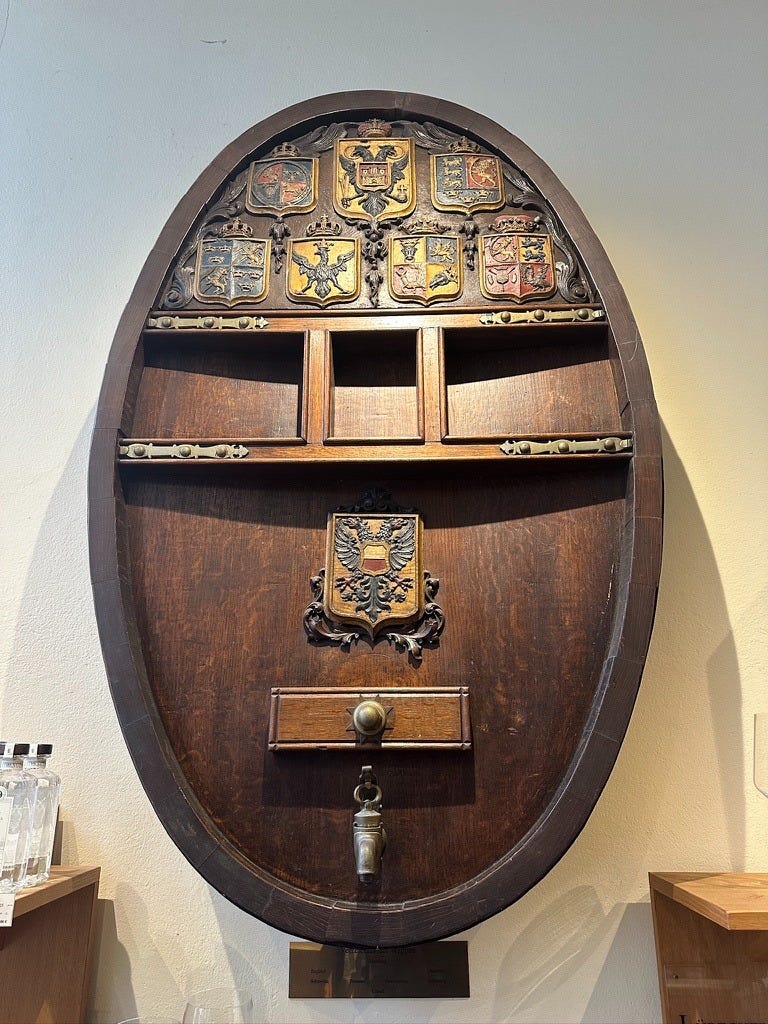
I asked about it.
The man shrugged slightly and said it had been there a very long time. I could not tell exactly how old it was, only that it felt as if it belonged to an earlier age. perhaps even to the Hanseatic world that had once tied these cities together through trade. Whatever its exact origin, it did not feel like decoration. It felt like a memory left standing.
I thought how strange and familiar it felt. It looked almost like the modern websites where one goes to buy something and finds a row of logos, trusted partners, guarantees, and affiliations. The same instinct, centuries apart: to show who stands behind the exchange.
And the wine itself told the same story. Lübeck did not grow the grapes. The value came from what happened between places, from transport, ageing, trade, and relationships carried over long distances.
I asked more questions about whether the shop had always belonged to the same family and how long it had been there. He answered each one calmly, exactly, without flourish. The building had been in one family for centuries, he said, until it changed owners in the 1980s; it is still privately owned.
What struck me was what he did not do. He never tried to impress me. He never began a speech about tradition or heritage. Everything I learned came only because I asked. There was no performance in the place, no attempt to convince me it was special. It simply was. The age of the wood, the quiet certainty of the man behind the counter, and the ancient emblems resting beside the wine all seemed to exist without the need for explanation.
And somehow, that made it more convincing.
I opened the bottle later that evening. The colour struck me first, a deep, almost dense red, darker than I expected, as if the wine carried time inside it. The taste felt aged and grounded, richer than the bottles I usually associate with Bordeaux, changed somehow by its journey north.
And I kept thinking about that plaque.
It struck me how unusual it was. I can’t recall a wine shop where the cashier’s story was about the cities it traded with, not the shop, lineage, prestige, or the house’s greatness. Most places want you to know their own history, how exceptional they are, and how long they have endured.
Here, the emphasis seemed different.
Instead of proclaiming its own importance, the shop pointed outward, toward partners, routes, and exchanges. The pride did not seem to lie in standing alone but in belonging to something larger, a network held together by trust.
And that, perhaps more than any explanation, said something about Lübeck.
It felt less like humility than a quiet pride, not in the house itself but in being part of a network strong enough to carry something across distance and improve it along the way.
For a merchant, perhaps there could be no greater achievement than this: to be the kind of trader others rely on, to be counted on year after year, shipment after shipment.
II. The City of Traders
That small wine shop began to feel like a miniature of the city itself.
What I had encountered there, the quiet pride in relationships, the emphasis on trust rather than self-display, was not an isolated curiosity. It pointed toward something larger that once defined Lübeck and many of the cities around the Baltic and North Sea: the world of the Hanseatic League.
These were not empires nor kingdoms ruled from palaces. They were cities bound together by trade. Merchants formed networks across water and distance, creating relationships that allowed goods, information, and reputation to travel together. Deals depended less on force than on reliability. A trader’s true capital was not simply what he owned, but whether others trusted him enough to trade again.
Among these cities, Lübeck stood at the centre. It was not merely another participant in the network but, for long stretches of its history, its leading force, the city whose influence shaped the rules and whose city hall functioned as a kind of political and commercial anchor for the League. Walking through Lübeck, one senses that history is everywhere: a city accustomed to coordinating, mediating, and setting standards for others.
If a ship failed to arrive, if a cask did not match its promise, or if a merchant gained a reputation for deceit, the consequence was immediate. Trade stopped. Without trust, there was no transaction at all.
Long before modern legal systems stretched across borders, these cities developed mechanisms that made agreements work. Contracts were respected because the alternative was exclusion from the network itself. City halls and local authorities existed to secure these arrangements, not to direct trade, but to protect the conditions that made voluntary exchange possible. Enforcement appeared only when agreements were broken.
The success of one trader strengthened another. A merchant who sold good wine created demand for the exporter who supplied him, and the exporter in turn, relied on the merchant’s ability to maintain trust with customers. Value emerged not merely from the goods themselves but from the network of relationships that sustained them.
It is difficult to look at this system without recognising in it some of the earliest expressions of what we would later call capitalist principles: voluntary exchange, long-term self-interest, reputational capital, and prosperity created through cooperation rather than coercion. Wealth emerged not through aristocratic privilege or conquest, but through merchants and craftsmen whose success depended on being worth trading with.
In a world still largely organised around bloodlines and titles, Lübeck ran on something more fragile and more demanding: a reputation that had to be rebuilt with every shipment.
Suddenly the emblems I had seen everywhere in Lübeck made sense. In markets, shops, and city buildings, the seals of other cities appeared again and again. They were not decorative. They were statements of credibility, visible reminders that prosperity depended on trust maintained over generations.
III. The City Hall
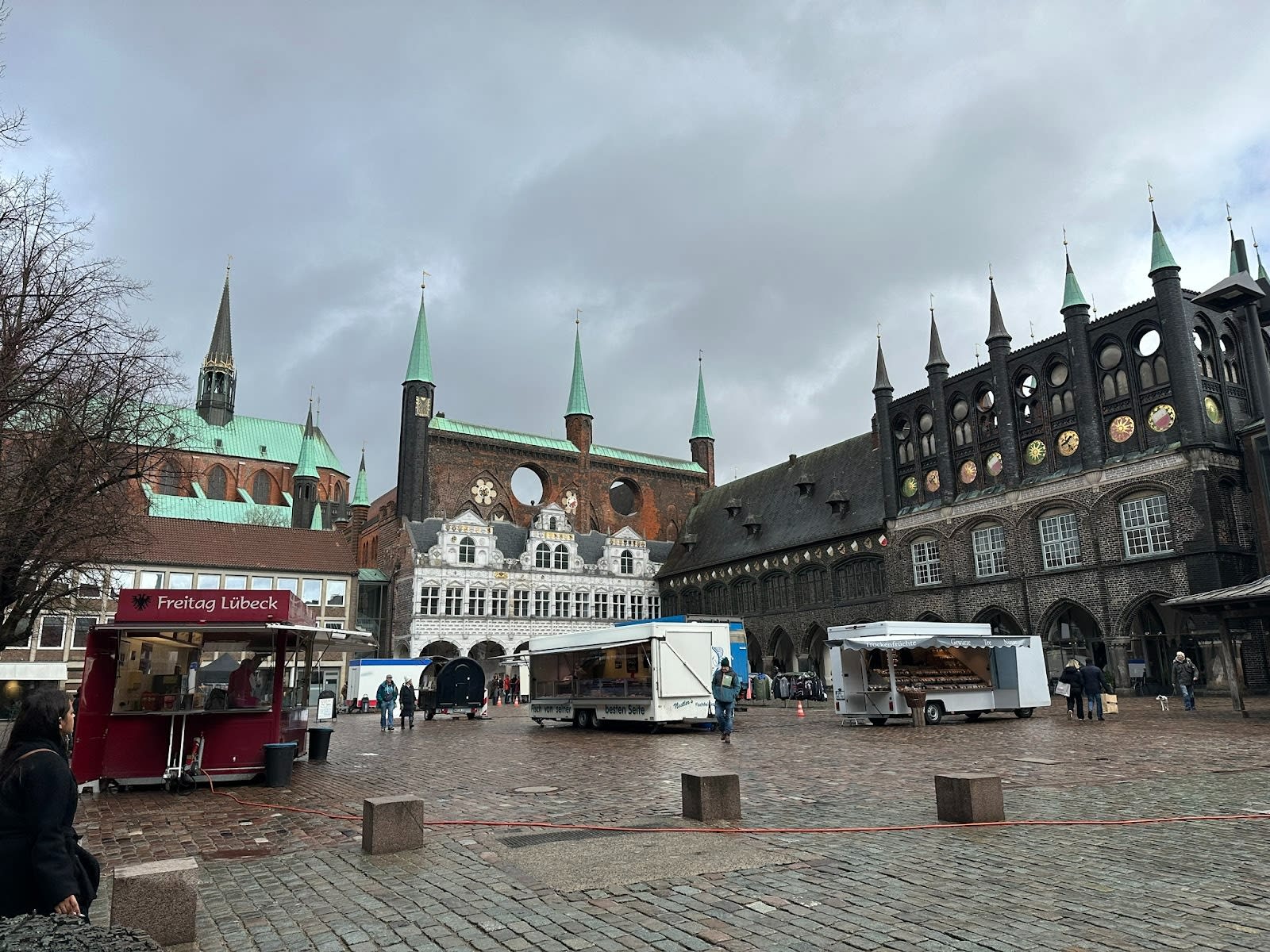
At the centre of Lübeck stands the building that tells you much about the city, and, unlike many medieval cities, it is not the church.
It is the city hall.
The Rathaus is, at first encounter, a confusing object. Photographs never quite prepare you for it. Standing in front of it, you realise it does not entirely make sense as a single building. Parts of it rise from the medieval period; others were added during the Renaissance. Styles overlap without fully blending. It feels less designed than accumulated, as if each generation simply added what was needed, negotiating with what already stood there rather than replacing it.
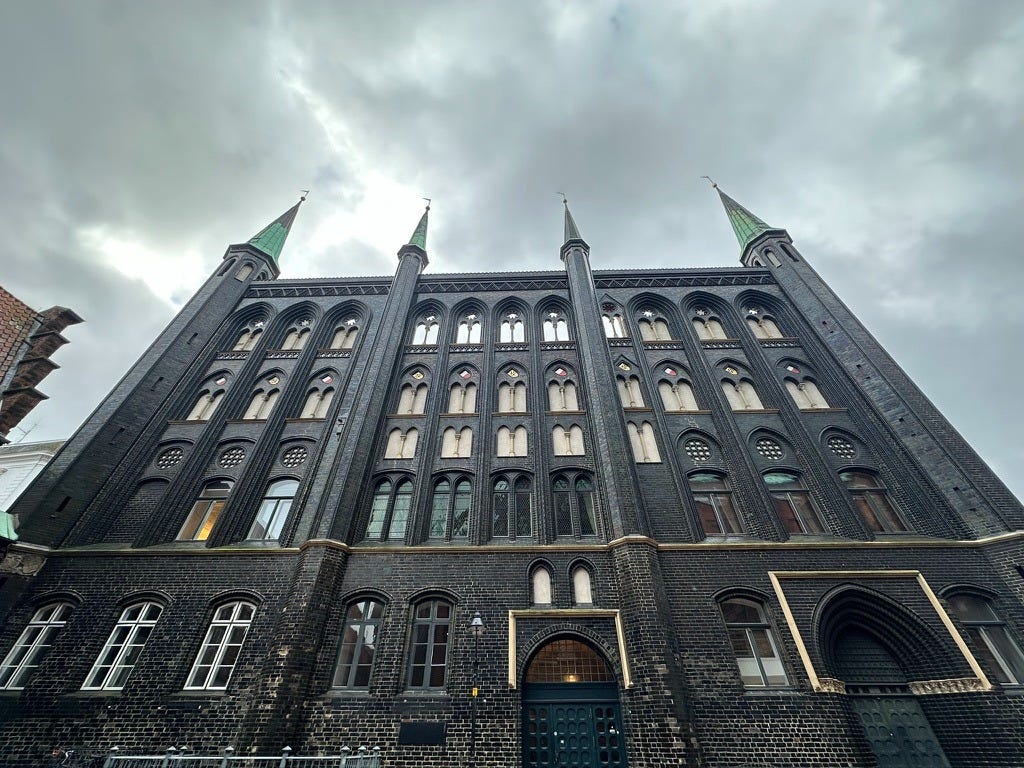
The Gothic section rises like a wall, tall, severe, almost fortress-like, crowned with pointed forms that pierce the sky, each carrying small flags. Red brick repeats in patterns of black and white, broken by emblems and symbols of both the city and the Holy Roman Empire. Seen from below, it is imposing enough to make you feel small, much like a great church.
And yet the building resists becoming purely monumental. The great windscreen walls, pierced by circular openings, soften the severity in a strange way. They look almost theatrical, like a stage set rather than an impenetrable façade. You can see through them. The structure presents itself rather than sealing itself off, suggesting a civic space meant to be witnessed rather than feared.
There is something telling in how the building orients itself. The severe Gothic wall, the part that feels most like a fortress or a cathedral, faces the church directly, as if acknowledging a rival in the same language. The more open side, theatrical and permeable, turns toward the market and the street, toward the people and the trade it existed to serve.
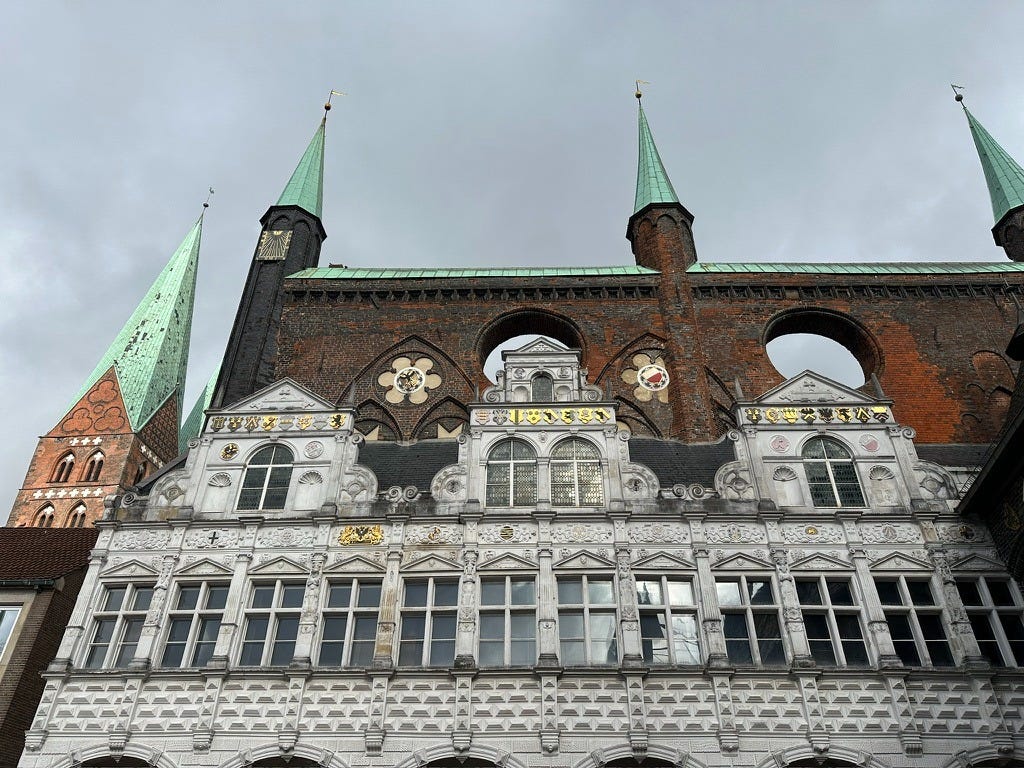
At street level, the tone shifts again. Renaissance additions introduce elegance where the Gothic had been severe. Here appear once more the familiar emblems, cities, partners, and allies, arranged almost like a catalogue of relationships. Gold glimmers in the details. The message is unmistakable: this is wealth, but wealth born from exchange.
What struck me most was how the building faced the market square. The Rathaus does not turn away from commerce; it looks directly onto it. Authority and exchange stand opposite one another, in conversation. The city hall governed the marketplace but was also visibly dependent on it, a reminder that civic power here emerged from trade rather than standing above it.
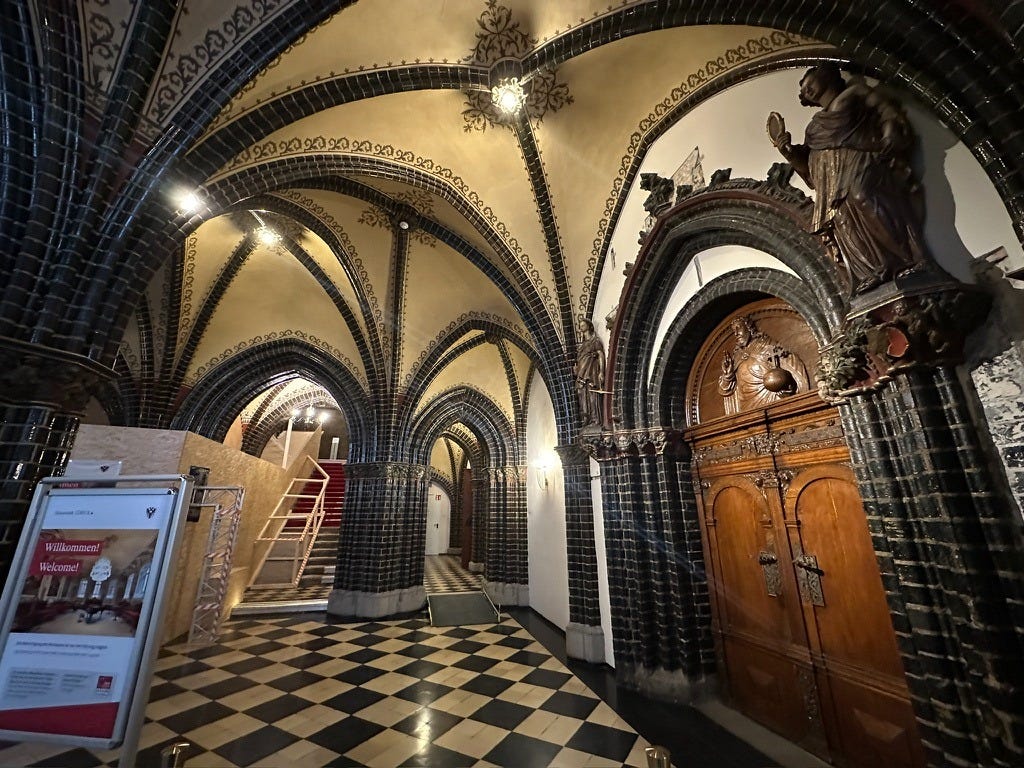
Standing there, the building felt almost like a city within a city. Not a space meant for everyone, but a place where serious matters were decided: contracts, disputes, agreements, and the quiet machinery that allowed trade to continue. The exterior could feel stern, almost defensive, but inside the rooms were lavish and richly decorated, designed not only to impress but to signal stability and continuity.
It was not what one imagines when thinking of a modern city hall. Today such places often evoke bureaucracy or administration. Here, the feeling was different. This was a seat of power directly connected to commerce, a place meant to ensure that agreements were honoured, that disagreements could be resolved, and that the city’s reputation remained intact.
Because reputation was everything.
The good name of Lübeck was not an abstraction; it was a practical necessity. If the city failed to protect fairness and reliability, trade would move elsewhere. Authority existed not to replace exchange but to safeguard it.
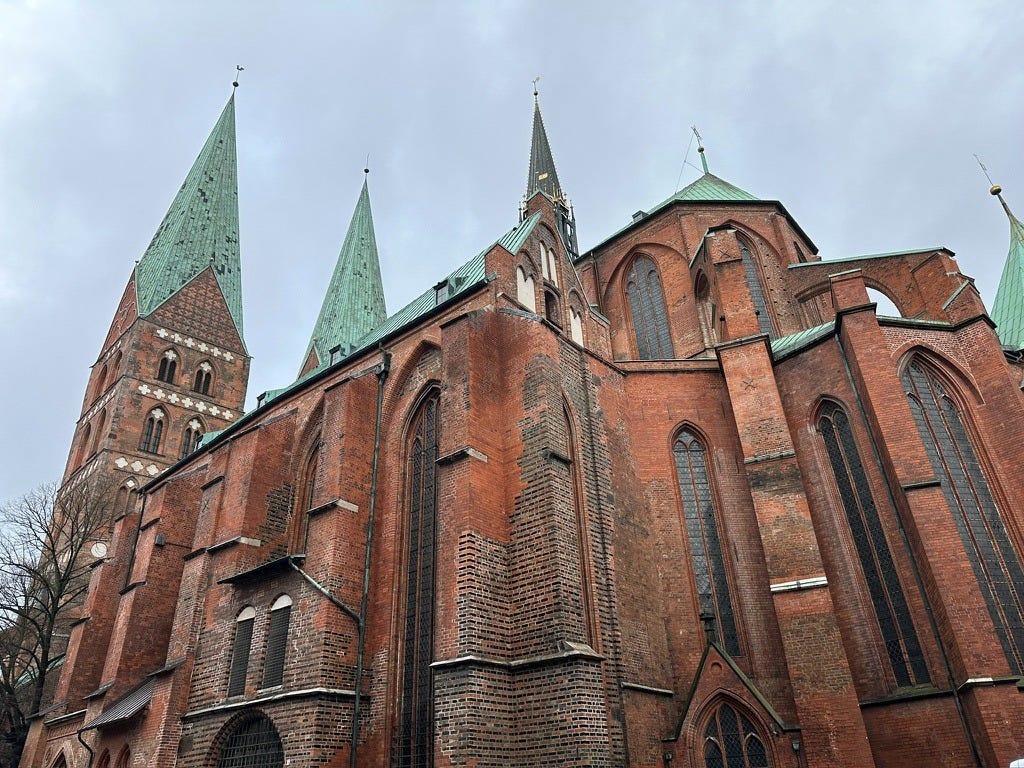
Beside the Rathaus stands a great church, beautiful, towering, and open to the public. While standing between the two, it was impossible not to notice where the center of gravity seemed to lie. The church represented spiritual life; the city hall represented the secular order that governed daily exchange.
Whether consciously intended or not, the impression was clear: here was a city where civic authority and trade stood at the heart of its identity.
Lübeck felt like one of those early moments in European history when power began to shift, when contracts and cooperation started to rival faith as the organising principle of urban life.
IV. The Modern Distance
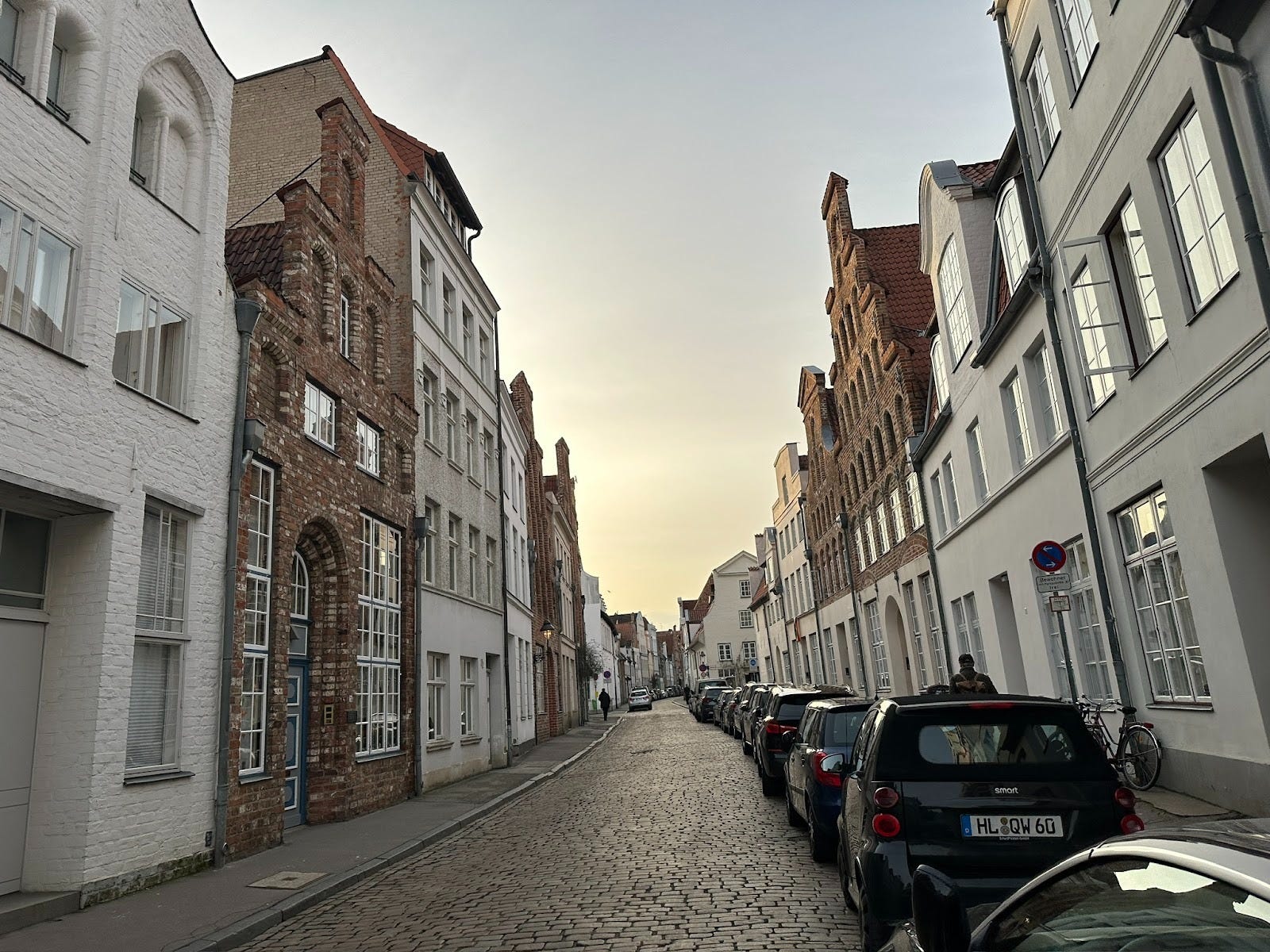
Walking through Lübeck today, it is impossible to pretend that the city exists unchanged. The Hanseatic world is gone. The ships are different, the markets globalised and the political order entirely transformed. Whatever mediaeval realities existed alongside this system, and there were many we would not wish to repeat, belong to their own time.
And yet something remains visible.
What lingers is not the structure itself but an idea: the assumption that trade is fundamentally a relationship, not a contest. Everywhere in the city, in its emblems, its architecture, and its quiet pride in partnerships, one senses a worldview in which exchange was understood as mutually beneficial. Prosperity did not come at another city’s expense but through cooperation sustained over time.
Modern discussions about trade often sound different. Trade is frequently spoken about in terms of winners and losers, deficits and tariffs, as though exchange itself was a zero-sum game. Economic relationships are measured by imbalance rather than by the value created between participants.
It is a telling irony of our modern vocabulary that our primary tool for ensuring a fair market is called “anti-trust” law. In the Hanseatic world, trust was the very soul of the market, the invisible bond that allowed a shipment from Bordeaux to be aged and sold in Lübeck with total confidence. Today, we treat “trust” as a threat to be dismantled, a synonym for a corporate cartel. We have moved from a system where trust was the foundation of the market to one where ‘Trust’ is a legal liability to be dismantled. In Lübeck, the merchant’s word was his heaven; in the modern world, the contract is our only security.
From the perspective of Lübeck, this way of thinking would have felt alien.
The merchants’ loyalties were shaped less by the will of a single ruler and more by the network that sustained their prosperity. What mattered was not devotion to a distant sovereign, but reliability within the circle of exchange itself. In that sense, loyalty flowed toward relationships chosen freely, toward agreements that served one’s long-term interests, rather than toward arbitrary authority.
Trade was not a loss to be minimised. It was a relationship to be maintained.
This is perhaps what still feels advanced about the city. Not its age, nor even its wealth, but the mentality embedded in its streets: the understanding that long-term prosperity depends on trust, and that trust depends on seeing others not as adversaries but as partners in mutual gain.
And perhaps that is why Lübeck feels so alive today.
The old city is small enough to cross on foot in twenty minutes, endlessly walkable, and filled with restaurants, wine bars, antique shops, rare books, silverware, jewellery, and small treasures tucked into narrow streets. History does not sit behind glass here; it appears casually on corners, in names, and in quiet emblems that refer to cities long gone or renamed, Danzig among them, reminders of a world held together by trade.
You notice it in places like that small wine shop, still selling Rotspon centuries after the idea first appeared, still living by relationships that began far beyond its walls.
Lübeck does not feel like a city performing history. It feels like a city still inhabiting it.
And perhaps that is what makes it so enjoyable to visit. The past is not presented as nostalgia but as something continuous, something you can walk through, drink, and carry home in a bottle of dark red wine born from the journey between places.
If you enjoyed Philosophy: I Need It, and want to see more, you can support my work by buying me a coffee. Every contribution makes a real difference. Thank you!
An engaging article, well done. Trust in commerce is still alive and well in the most dynamic industries. I grew up in Texas and knew some independent oil operators. They still commit to multi-million dollar deals on a handshake. The tightest contract in the world won't protect a bad reputation.
Extraordinary. It reminds of a lesson I learned recently from another author. Businesses do not fail due to lack of capital. They fail when they lose trust.