

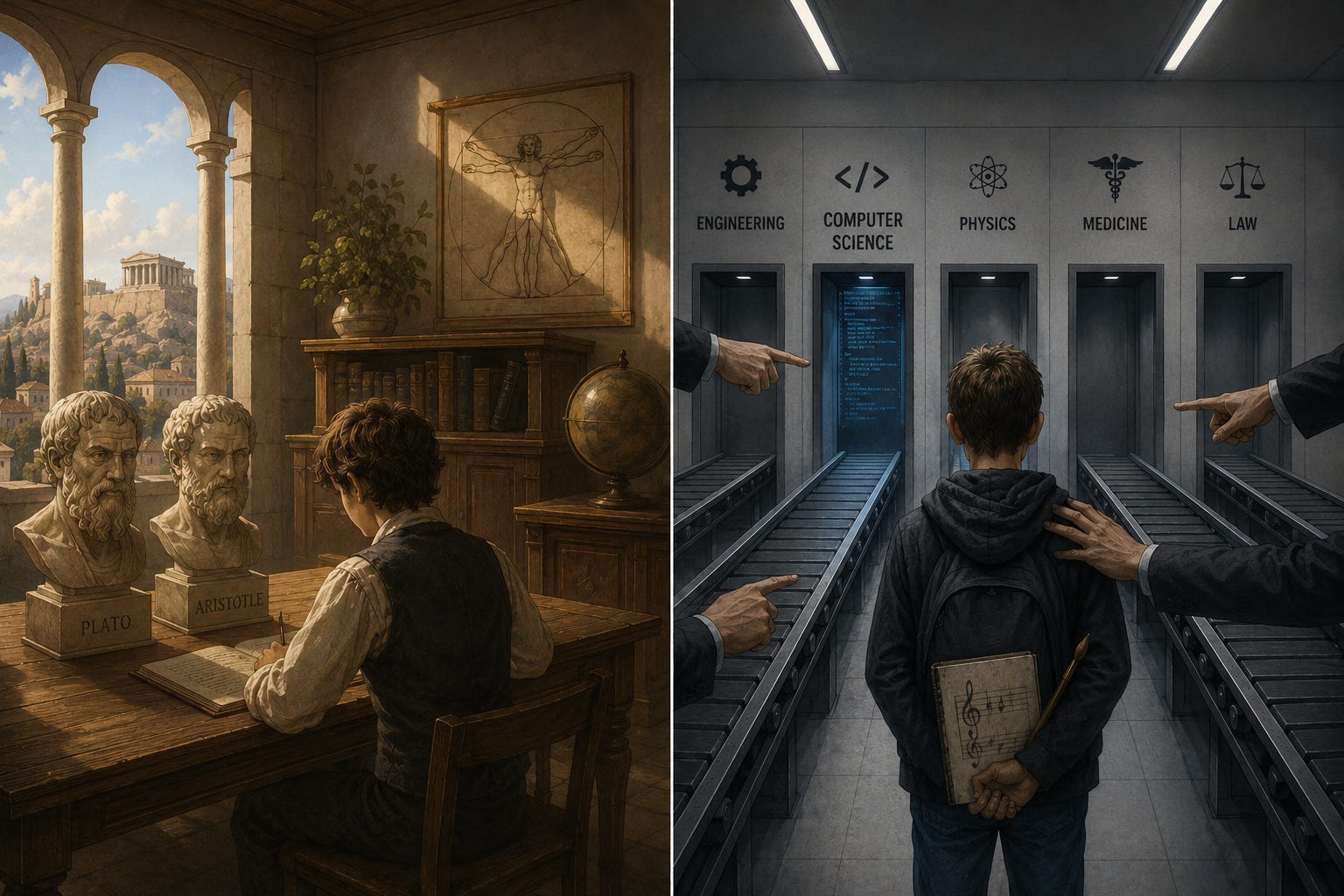
Thomas Mann’s novella Death in Venice is one of the most philosophically dense works of fiction I have encountered. Every page seems loaded with symbols, echoes, allusions, and ideas. Antiquity, Christianity, German culture, music, myth, beauty, decadence, discipline, disease, desire, and, of course, death are all compressed into a work that can be read in an afternoon but may accompany the reader for a lifetime.
What struck me most, however, was not only the brilliance of the novella. It was the amount of knowledge Mann assumes of his reader.
There are references and symbols in Death in Venice that would once have resonated more naturally with an educated reader but today feel distant, almost alien. I do not mean that the contemporary reader cannot understand the work. He can, with effort. But the effort itself is revealing. One senses that Mann wrote from inside a world of shared cultural references that no longer exists in the same way.
But why must it be like that?
Why should a work written a little more than a century ago feel, in some respects, as if it came from an extinct ancient civilisation? What does that say not only about Mann’s education but also about ours?
The Lost World of Bildung
The word that helps explain this vanished world is Bildung.
It is often translated as education, but that is too narrow. The German term ‘Bildung’ means ‘formation’: the shaping of a human being into a cultivated person. It was not merely the acquisition of information, the passing of examinations, or preparation for any specific profession. It meant giving a young person a world that unfolds across two axes:
Horizontally, it reached across many fields: languages, literature, music, history, philosophy, mathematics, physical culture, manners, rhetoric, art, and science. A young student in the educated German bourgeois world was not first asked whether he “preferred” music or literature, whether he was a “science person” or an “arts person”, or whether classical mythology, musical notation, or philosophical enquiries would be useful to his future career. He was expected to encounter them because they were considered a vital part of what becoming an educated human being meant.
Vertically, this education reached backward through time. The student was not handed a blank present and told to fill it. He was placed inside a long story: the literature of Greece and Rome, the music of Bach and Beethoven, the philosophical arguments of Plato and Aristotle, the architectural forms of temples, cathedrals, and civic buildings, the rhetorical traditions of the ancient forum. These were not presented as museum pieces or historical curiosities. They were presented as an inheritance: achievements that belonged to him because he was a human being entering a civilisation shaped by them. To know them was not to look backward. It was to understand that he stood on their shoulders.
Education, in this sense, was not merely the acquisition of knowledge. It was the formation of seeing. A child was being taught not only what to know but how to look at the world: what to notice, what to connect, what to admire, what to question, and what to regard as significant.
There is something deeply Greek in this ideal. It treats man not as a disembodied mind nor as a merely useful economic unit but as an integrated being: intellectual, moral, aesthetic, technical, and physical. A unity of mind and body. The educated person was expected to think, judge, speak, move, create, appreciate, and act. In that sense, Bildung was this-worldly. It was not education for escape from life, but education for fuller participation in it.
This is why physical culture belonged naturally to such an ideal. In 19th-century Germany, gymnastics and bodily training were not merely recreational “sports” in the modern sense. They were connected to discipline, coordination, endurance, posture, courage, and civic character. The body, too, was part of the formation of the person.
The same was true, in another way, of music. The point of musical education was not that every child should become a musician. The point was that music belonged to the world of cultivation. In bourgeois culture, the piano, singing, notation, and domestic music-making were not marginal amusements. They were part of the atmosphere of educated life.
A musical score is one of the great human inventions: a way of making sound visible, of preserving emotion and structure across time, of allowing a mind centuries later to enter the architecture of another mind’s creation. To be unable even to look at such a thing is to be excluded from part of civilisation.
The same applies to painting, architecture, literature, mathematics, philosophy, and history. One need not love every painting, every symphony, every sport, or every book. Taste will differ. Talent will differ. Specialisation will differ. But a formed person should be able to traverse the world and understand something of what he is seeing.
Education, then, was not meant to force every student into every field as a future professional. It was meant to open doors. Only later would specialisation come. One might become a lawyer, a merchant, a scholar, an artist, a doctor, or a civil servant. But before becoming a specialist, one was expected to become a person. Formation came before function.
This was demanding, and it should not be romanticised as if it were painless or universally successful. Thomas Mann himself was not a model schoolboy. He struggled with formal schooling and did not simply glide through the system as a perfect product of it. But that fact makes the matter more interesting, not less. Even a student who resisted or failed to master the system completely was still formed by a culture of enormous expectation.
This also reminds us that education is never only school.
He was not formed by the classroom alone, and perhaps not even primarily by it. He was formed by a household, a city, a class, a library, a musical atmosphere, a brother who would also become a writer, and a wider culture in which literature, music, philosophy, and artistic ambition were taken seriously. His father represented the sober Hanseatic world of commerce, civic duty, and bourgeois respectability. His mother brought into the family a more musical, artistic, and sensuous element. After his father’s death, the family moved from Lübeck to Munich, a centre of art and literature, where Mann’s artistic life could develop more freely.
This complicates the picture, but it also strengthens the point. Formation is not produced by a curriculum alone. It comes from the whole world surrounding the child: the home, the books on the shelves, the music being played, the conversations being had, the standards being assumed, and the possibilities being taken seriously.
That, I think, is part of the gift we received from him: not only the work of an individual genius but also the evidence of a world in which genius had material to work with.
But this admiration requires a warning.
The historical record forbids nostalgia. The culture that produced the world of Bildung also produced the catastrophe of Nazism. A culture can teach Goethe, music, discipline, manners, and classical references and still be poisoned by irrational ideas. It can cultivate taste without cultivating moral clarity. It can produce refinement without freedom.
So the lesson cannot be to return to Mann’s world. Much in that world was already rotten: irrationalism, collectivism, altruism, submission to inherited authority, and reverence for the state. A broad education is not enough if the ideas at its core are false. A cultivated man can still be morally confused. A musical nation can still become barbaric.
What is worth recovering is not the whole package but the principle of formation: the idea that education should make a person wider, deeper, and more capable of seeing the world and acting within it.
From Bildung to Ausbildung
In German, Bildung suggests formation: the cultivation of a person. Ausbildung means training: preparation for a particular occupation, craft, or professional role.
The contrast can be stated simply: what once came after formation now often comes before it.
Specialised training is not the problem. A serious adult life requires skill. A doctor must know medicine. An engineer must know engineering. A musician must master his instrument. There is dignity in competence.
The problem is that general education has increasingly taken the shape of specialised training. Before the student has been given a world, he is asked to choose a track. Before he has encountered literature, music, history, philosophy, science, art, physical culture, and the wider inheritance of civilisation as parts of life, he is encouraged to think of himself as “technical”, “artistic”, “scientific”, “practical”, or “creative”.
But these are not identities. They are premature reductions.
In other words, the modern student is narrowed along both axes. Horizontally, he is pushed into a track before he has encountered the breadth of life. Vertically, he is cut off from the inheritance that might have given his studies meaning. He is not given a world and then asked where he wishes to stand within it. He is given a function and asked to become useful.
Schiller saw this danger already at the end of the eighteenth century. In his Letters on the Aesthetic Education of Man [1], he argued that modern culture had broken the inner unity of human nature. The sciences had become more sharply separated; occupations more narrowly divided; the faculties of the mind forced into hostile compartments. Modern man, he warned, could become chained to “a little fragment of the whole,” until he was no longer a whole human being but the living imprint of his craft or science.
That is precisely the danger I am trying to describe.
The problem is not specialisation as such. The problem is specialisation before formation: the reduction of the person to a function before he has been allowed to become a person.
I do not need to look far for an example of this. I saw it in my own education.
In my own high school years, not very long ago, this narrowing was already built into the system. One could choose “arts”, of course, but even there the category was immediately broken apart. Visual art was one thing. Music was another. Literature was somewhere else. The arts were not presented as different expressions of a single human need to perceive, create, and give form to experience. They were separate tracks.
On the other side were the “serious” choices: physics, biology, chemistry, economics, and computer science. These were the subjects one chose if one was practical, ambitious, sensible, and future-oriented. Or, often enough, if one’s parents wanted him to be those things.
This created a world of arbitrary dichotomies: art or science, beauty or usefulness, passion or security, music or career, painting or seriousness, computer science or failure. And the one discipline that should have helped a young person question these false alternatives, philosophy, was almost entirely absent.
Even the body was not treated as part of formation.
Physical education, in my experience, was mostly a checkbox. Run a certain distance in a certain time. Complete the requirement. Receive the mark. Move on. It was not presented as the cultivation of strength, coordination, endurance, courage, discipline, self-command, pleasure in movement, or a lifelong relation to the body.
That is a small example, but it reveals the same pattern. A formed person should not be a mind dragged around by a neglected body. He should be active. He should be capable of movement. He should be exposed to different forms of physical excellence, not because every child must become an athlete, but because the body, too, is part of life.
Instead, physical education often became another bureaucratic requirement: not formation, but completion.
I remember this same failure most vividly in mathematics.
When we were first introduced to derivatives, I asked what seemed to me the obvious question: What is a derivative? What am I actually doing here? Why does it matter?
The answer shocked me. The teacher said that explaining it properly would take the whole class, and therefore, we should not bother with it. What mattered was learning what we needed to know for the exam.
I have never forgotten that answer, because it revealed the entire philosophy of the system. Meaning was treated as a distraction from the procedure. Understanding was subordinate to performance. The child’s desire to know what a thing is was less important than the machinery of assessment.
A derivative should have been introduced as one of the great conceptual tools by which the human mind grasps change: motion, growth, acceleration, curves, rates, and the structure of reality in movement. Instead, it was presented as an exam technique.
And so I was not merely left ignorant of mathematics. I was taught to despise it.
That is perhaps the worst thing bad education can do. It does not simply fail to teach a subject. It turns the student against it. It takes something profound and makes it appear dead, arbitrary, bureaucratic, and hostile. It teaches the child to associate knowledge not with discovery, but with humiliation, boredom, pressure, and resentment.
It is absurd to ask a sixteen-year-old to make life-shaping decisions with any real knowledge of the world. What does he know, at that age, about business? About markets? About how jobs are created? About how professions change? About how a life is actually built? Very little. How could he? He has barely begun to encounter the world, yet he is already asked to narrow himself in preparation for it.
The parents who push their children toward the practical choice are not necessarily to blame. Often, they are responding rationally to the structure placed before them. The system demands early choices, so they try to guide the child toward the path that seems most secure. Their error is not usually malice. It is fear. And fear travels from the system into the home.
But fear is a poor foundation for education.
The child learns to speak with an adult’s exhaustion before he has had an adult’s experience. He says, “What will I do with music?” “What will I do with painting?” “I should be serious.” “I should study computer science.”
This is how a culture of narrowing reproduces itself. The school demands premature specialisation; the parents internalise the demand; the home then reinforces the school; and the child experiences the whole thing as reality itself.
But these are not really his thoughts. Not yet. They are the inherited anxieties of a world that has stopped believing in formation.
I remember one childhood friend in particular. From a very young age, perhaps five or six, he spent hours every day at the piano. Hours. This was not a casual hobby. He loved it. He was serious about it. He had already entered, as a child, into one of the great disciplines of civilisation.
And yet, when the time came to choose a track in school, he chose physics.
Not because he had stopped loving music. Not because physics had revealed itself as his deeper calling. But because physics was the “practical” choice. I remember him becoming more cynical as we approached graduation. Something in him seemed to yield. There was a sense, at least to me, that he had already learnt to give up.
But why did he have to choose?
Why could he not have had both? Why should a child with a serious love for music have to give it up in order to be “practical”? Why should physics and piano appear as rival futures rather than different forms of discipline, intelligence, and contact with reality?
This is the injustice of premature narrowing. The child is forced to abandon parts of his possible self before he has had time to discover what they might become.
And the irony is that this narrowing does not even reliably produce excellence. It often produces mediocrity. A student who chooses a field out of fear, without love, without breadth, without a wider understanding of life, may become technically trained but spiritually undernourished. He may acquire a function without developing the range, passion, judgment, or adaptability needed to excel in it.
The “practical” path, then, may turn out not to be practical enough.
We can already see this in the anxiety facing many young programmers and computer science graduates. For years, students were told that coding was the safe choice, the serious choice, the future. And then the future changed. AI, automation, offshoring, hiring freezes, and the changing economics of junior work have made the old promise far less secure. In Israel, too, the junior tech market no longer feels like the guaranteed paradise many students were once promised.
This is where people often turn the matter into a mystery. How can it be, they ask, that in an age of such extraordinary tools, education has not been transformed? How can students carry in their pockets more books, lectures, music, images, maps, courses, languages, and technical aids than any previous generation could have imagined, and still emerge so poorly formed?
But there is no mystery here.
The failure is not technological. It is philosophical.
Technology can make knowledge available. It cannot tell a child what is worth knowing, how things connect, or why they matter. It cannot supply hierarchy, purpose, standards, or integration.
The problem is not that we lack resources. The problem is that we no longer know how to order them into the formation of a person.
This does not mean computer science is worthless. That would be absurd. It means that no narrow track, however fashionable or useful at a given moment, can substitute for education. The world does not merely need people who can perform a procedure. It needs people who can think, judge, create, adapt, communicate, connect fields, understand human beings, and reinvent themselves when the ground shifts.
A child who is specialised before he is formed is not educated. He is pre-formed: shaped in advance for a function he may not love, in a world that may no longer exist by the time he reaches it.
And if formation is the shaping of a person toward fuller contact with reality, then premature narrowing is its opposite. It does not merely fail to form. It deforms. It bends the child away from the breadth of life before he has had the chance to encounter it.
Formation gives a child a world. Specialisation gives him a function.
The former asks: What kind of person is being formed? The latter asks: What task can he perform?
Formation
What I would want for my children, one day, is not merely that they will be successful. I would want them to be well-versed in the world.
I would want them to know enough of the world to choose their place within it.
A child should be introduced to literature, music, art, science, mathematics, history, philosophy, language, business, physical culture, and the great achievements of civilisation, not because he must become an expert in all of them, but because he must learn what kind of world he is entering.
If you do not understand the world, how can you act within it? How can you shape it? How can you know what is genuinely yours to do?
You can obey. You can perform. You can follow instructions. You can accept the path handed to you by parents, teachers, employers, bureaucracies, or markets. But to choose a life, one must first have encountered enough of life to choose intelligently.
That is what formation means.
Formation also suggests a different way of thinking about knowledge itself. Knowledge should not be piled up as disconnected units. It should grow as a continuous spiral: from the world to ideas and from ideas back to the world; from concrete experience to abstraction and from abstraction back to deeper perception. Each return should make the child see more than he saw before.
A proper education does not merely add subjects. It integrates them. Mathematics should deepen one’s understanding of motion, change, and structure. History should illuminate the present. Music should refine one’s perception of form and emotion. Philosophy should teach one to think in principles. Physical culture should make the body part of one’s active life. The parts should not remain parts. They should become part of a widening grasp of reality.
It is not the opposite of specialisation. It is the condition that makes specialisation meaningful. A young person should eventually choose a field, a craft, a profession, or a mission. But he should choose as someone who has seen enough of the world to know what he is choosing.
This is the education I wish I had received. It is the education I would want to give my children. And perhaps it is also the education we must continue giving ourselves.
Formation does not end with school. The best education should teach precisely that: one’s formation is never finished. Life is full of learning. A human being should remain open to new knowledge, new beauty, new skills, new disciplines, and new integrations. He should want to understand more, see more, hear more, build more, and become more.
Not in order to become a specialist sooner or to function more efficiently, but in order to become more fully a person.
That is what I would want for my children: not that they inherit my tastes, my interests, or my conclusions, but that they inherit a world wide enough to choose their own.
[1] - Friedrich Schiller, Letters on the Aesthetic Education of Man, Letter VI.
This was an eloquent commentary on Western civilization as experienced by the individual person.
A poignant topic, very eloquently expressed. I'm sure anyone who reads this will also find it highly relatable when reflecting on their own journey through life; I certainly did. Specialisation too soon leads to regression and confusion as opposed to expansion and clarity. I sometimes describe it as living life in reverse, and have met others who feel similarly. Thank you for your wisdom and insight, I have found it rather soothing today.