

I. Finishing The Job
These days pull me back to June.
To those strange, electric days when the war with Iran began not in fear, but in something dangerously close to joy. Not joy at destruction, joy at clarity. Joy at the feeling that, at last, the job would be done. That history had opened a narrow window, and that we had finally stepped through it.
For a brief moment, it felt as though the long paralysis had broken. The missiles still fell, the sirens still howled, but beneath it there was something new: confidence. Direction. A sense that this time, we would not stop halfway. That this would not be another chapter in Israel’s long tradition of winning tactically and surrendering strategically.
And then, as always, we stopped.
Not because we were beaten.
Not because we ran out of capability.
But because we once again refused to finish what we had started.
I wrote that we would pay for it later. That the bill would come due. That unfinished wars do not disappear; they wait.
So far, the price has been paid almost entirely by others.
By Iranian men and women who believed that Israel and the United States would finally finish the war that the regime declared. That the world, finally, would not look away. That Israel and the United States would finally act in their own defence, and in doing so, break the regime’s grip.
They paid with their lives.
Thousands butchered in the streets.
Thousands more disappeared into prisons, torture chambers, and silence.
That alone should command moral clarity and solidarity, but it does not, by itself, warrant risking the lives of Israelis or Americans.
What does warrant it is: self-defence.
The Iranians now being butchered in their own streets are not the only ones who are now paying and will continue to pay the price for having this evil regime.
We will pay too.
We will pay in missiles over Tel Aviv.
We will pay in funerals.
We will pay in children running to shelters, again and again, because we mistook restraint for wisdom and delay for strategy.
Israel’s refusal to win wars is not unique to Iran.
It is the same disease we see in Lebanon.
The same refusal in Gaza.
The same pattern, repeated until it no longer shocks: strike hard, stop early, declare victory, and prepare excuses for the next round.
We do not lack strength.
We lack resolve.
And that failure, not the war itself, not the enemies we face, is becoming the defining legacy of Netanyahu.
He will be remembered not as the man who warned of danger, but as the man who recognised it, confronted it, and then chose to leave it alive. Unless, of course, he changes course, there’s still time.
II. The Willingness to Bear the Cost
What many outside Israel and even many from within don’t quite understand is the willingness of the Israelis to suffer the consequences of war with Iran.
I was in Tel Aviv the entire time. I felt it in the streets, in the shelters, in the silences between sirens. People were not euphoric in a childish sense, but there was something steadier and more serious, acceptance.
It was understood, almost instinctively, that this would be hard. That it would be unpleasant. That we would spend long hours underground, wake up at night, cancel plans, watch buildings burn, and bury the dead. No one pretended otherwise.
And yet the mood was not despair.
It was resolute.
There was a quiet consensus that if this is what it takes to finally remove the hammer hanging over our heads, then so be it. For as long as I can remember, growing up in this country meant living with an unspoken sentence: maybe one day you will wake up to a nuclear mushroom cloud. Not metaphorically. Literally.
That is not paranoia. That is what the Iranian regime has promised us, openly, repeatedly, for decades.
And suddenly, suddenly, there was a chance to end it.
We watched our pilots fly missions that will be studied for generations. We watched intelligence operations unfold with a precision that bordered on the unbelievable. Mossad agents walking into the heart of darkness. Pilots flying into hell and returning.
It brought joy, not the joy of destruction, but the joy of competence. Of seeing Jewish sovereignty act like sovereignty. Of knowing that this time, we were not begging history for mercy, but shaping it.
Yes, it was painful.
Yes, seeing our brothers and sisters killed was unbearable.
But morale did not break.
People did not panic. They did not demand surrender. They did not beg for “quiet at any price.” There was no mass hysteria, no collapse into defeatism. If anything, there was a rare sense of unity: do what needs to be done, and finish it.
That is why what followed felt like betrayal.
Not just a strategic betrayal, but a psychological one.
The sudden halt did not bring relief. It brought cynicism. It taught people, once again, that courage is permitted only up to a point, and that clarity will always be interrupted by someone else’s comfort.
And now, watching it unfold again, watching Iranian civilians pay with their lives for believing that this moment was real, the bitterness cuts even deeper.
For now, the price is not being paid primarily in Tel Aviv.
For now.
It is being paid in Iranian blood. In crushed protests. In shutdown internet lines. In mass graves, we will only learn about years from now.
That is tragic in itself.
But tragedy deferred is not tragedy avoided.
If this regime survives, if it learns, adapts, and rebuilds, the price will come back to us. It always does. In missiles. In funerals. In children raised under sirens.
And the most corrosive cost of all will be this: the slow replacement of resolve with cynicism. The sense that even when we are willing to endure hardship, even when morale holds, even when history opens a door, someone will always step in to close it.
That is how nations lose their future.
Not because they cannot fight.
But because they are not allowed, or do not dare, to finish.
III. The War America Refused to Name
Iran is not drifting toward war with the United States.
Iran has been at war with the United States since 1979.
This is not rhetoric. It is not a metaphor. It is not ideological exaggeration. It is the regime’s own definition of itself.
From the moment the Islamic Republic seized the American embassy, paraded American diplomats as trophies, and ritualised humiliation as a founding act, the regime declared war, not only on Israel, but on America as such. Not on policies. Not on administrations. On the civilisation it calls the Great Satan.
That language was never symbolic.
It was programmatic.
The Islamic Republic does not see America as a rival. It sees it as an enemy to be defeated, exhausted, humiliated, and ultimately erased. This has been stated openly, repeatedly, for decades, in sermons, in slogans, in doctrine, in action.
What is extraordinary is not Iran’s clarity.
It is America’s denial.
For nearly half a century, the United States has refused to acknowledge that it is already in a state of war. It has treated Iranian aggression as a series of isolated incidents: a hostage crisis here, a proxy attack there, a missile test somewhere else. Always something to be managed, contained, and negotiated.
Never something to be finished.
And so Americans ask, sincerely or cynically: Why is this our problem? Why is this about us?
The answer is quite straightforward:
Because the same regime that chants “Death to America” as it develops intercontinental ballistic missiles and nuclear weapons, should be taken seriously.
And because that regime is no longer content with regional reach.
This is where the refusal to name the war becomes suicidal.
Iran is not merely developing nuclear capabilities. It is developing delivery systems, intercontinental ballistic missiles, whose purpose is not Tel Aviv.
It is New York.
A nuclear Iran is not a Middle Eastern problem. It is a global threat with an explicitly American target list. The idea that Israel is “dragging” the United States into something misunderstands the order of causality entirely.
Israel is fighting the war Iran has already declared, and America has refused to admit.
This is why the present moment matters so profoundly.
For the first time since 1979, the regime is exposed simultaneously on three fronts:
Militarily
Economically
Internally
And yet, once again, America hesitates, not because it lacks power, but because it still refuses to accept the premise that there is a war at all.
You cannot win a war you refuse to name.
You cannot deter an enemy whose ideology you pretend is negotiable.
And you cannot plead ignorance when the missiles are no longer theoretical.
History will not ask whether America intended to confront Iran.
It will ask whether it recognised reality before reality arrived on its shores.
IV. The Iranians
There is no honest way to talk about the future without talking about the Iranian people.
And there is no honest way to talk about the Iranian people without saying something uncomfortable.
Yes, they live under a brutal, suffocating, murderous regime.
Yes, dissent is punished, often fatally.
Yes, fear is real, and courage is costly.
All of that is true.
But it is also true that regimes do not float above societies like weather systems. They are sustained, materially, socially, and psychologically, by the people beneath them. Through taxes. Through labor. Through silence. Through inaction. Through the decision, repeated millions of times, to endure rather than confront.
This is not a moral condemnation. It is a statement of reality.
When the mushroom cloud eventually rises, if this regime is not stopped, it will not ask who was oppressed and who was complicit. It will not distinguish between protesters and loyalists. It will not care who was brave in private and silent in public.
There is another truth that must be stated, however uncomfortable it may be.
History does not adjudicate the inner thoughts of populations when the machinery of annihilation is set in motion. The Jews who were murdered in Auschwitz were not spared because some Germans resisted the regime, or because there existed underground networks, or because many citizens lived in fear rather than enthusiasm. Whatever private doubts or quiet opposition existed within Germany did not stop the trains, did not halt the gas chambers, and did not prevent the Second World War.
Six million Jews were murdered. Europe burned. And history did not absolve Germany on the grounds that “not everyone agreed.”
That is not cruelty. It is reality.
In the same way, when a regime builds weapons of mass annihilation and openly declares its intent to use them, the question of private dissent within the population, while morally relevant, does not alter the consequences. Nuclear war does not discriminate between protesters and conformists. It does not pause to examine who paid taxes willingly and who did so under duress.
This is not a moral condemnation of the Iranian people. It is a recognition of the tragic structure of total war.
The German regime was brutally oppressive. Resistance existed. Fear was widespread. None of that prevented catastrophe. The burden of history still fell where power was enabled, sustained, and left unbroken.
The same standard must apply here.
In June, I was angry, deeply angry, because I saw an opportunity that was not taken. The regime was exposed. Its defenses punctured. Its myth of invincibility was shattered. Israel even called the Iranians to rise up against their oppressive regime, and yet the streets of Iran, despite the sky being ruled by Israeli jets, remained largely quiet. That silence mattered. It may have cost history its best chance.
Now, months later, something has changed.
Not because the regime softened, it never does, but because economic collapse finally forced reality through the cracks. And when the Iranian people rose, they did so with astonishing courage.
I will say this clearly: what we have seen in recent days is heroic.
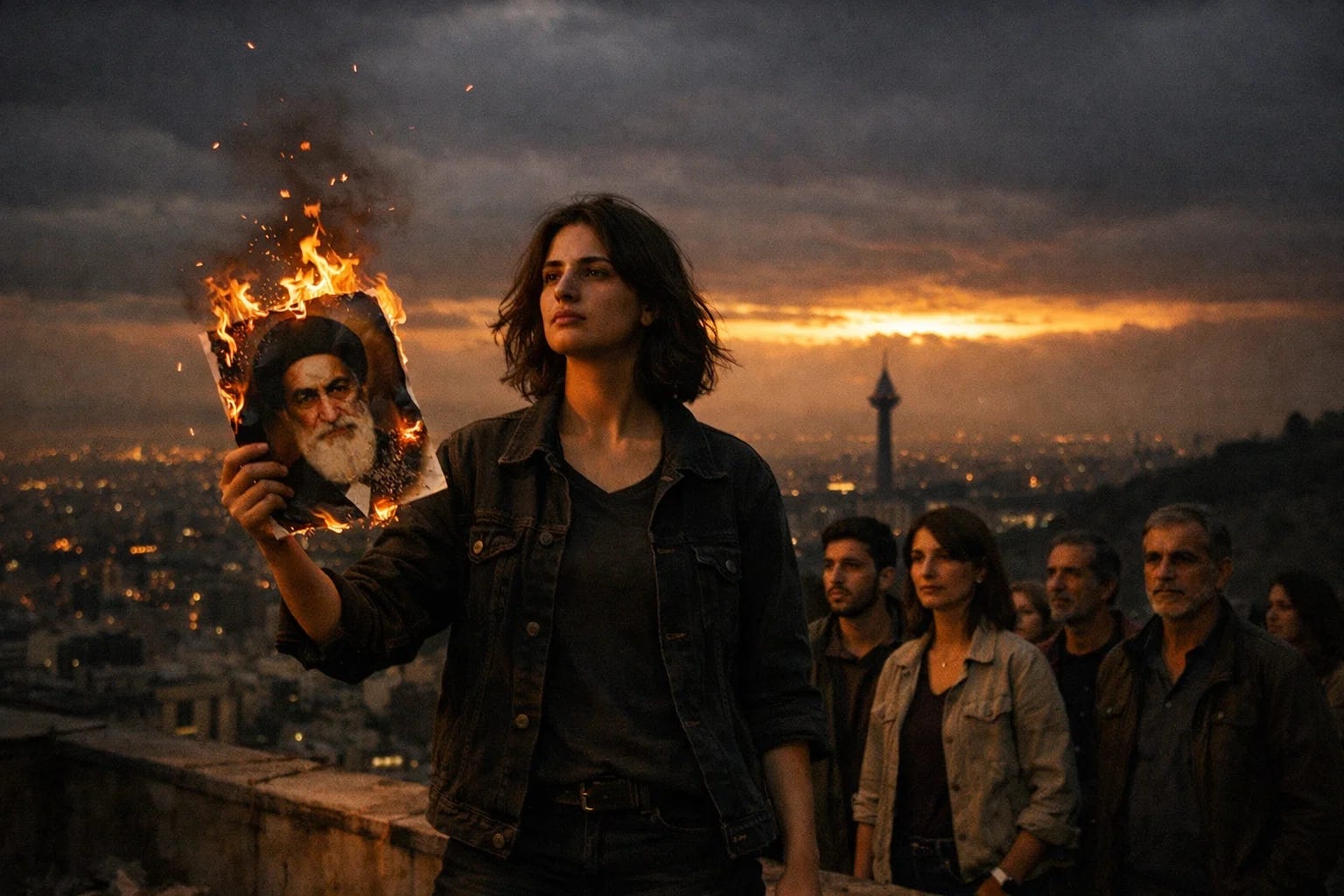
Women burning the images of their Ayatollah in the open street.
Men chanting freedom, knowing exactly what the price might be.
People standing upright after decades of enforced submission.
It was a beautiful sight. I wrote about it. I meant it.
And now, as the regime responds in the only language it knows, mass murder, disappearances, darkness, my thoughts are with them. Genuinely. The courage it takes to persist under such conditions is immense.
But here is the line that must not be crossed, even in sympathy:
It is not the responsibility of Israel, or of America, to give freedom to the Iranian people.
Freedom is not a humanitarian export.
It is not something one nation owes another.
The moral responsibility of a state is first and foremost the defence of its own citizens.
From that perspective alone, those who argue against intervention are not wrong in principle.
And yet, here is the crucial point: Intervening now is self-defence.
The same regime slaughtering protesters today is building the weapons that will kill Israelis tomorrow and Americans the day after. The same apparatus crushing dissent is refining delivery systems designed for cities that are not Iranian.
Leaving the Iranian uprising to be crushed is not merely tragic. It is strategically suicidal.
It is a betrayal of ourselves.
It is the abandonment of Israeli children who will grow up under nuclear threat.
It is the abandonment of Americans who believe geography still protects them.
It is the abandonment of the future in exchange for a few years of quiet.
That is why this moment matters.
Not because we owe Iranians freedom, they owe it to themselves.
But because helping dismantle the regime that enslaves them is inseparable from defending our own lives.
To walk away now is not a restraint.
It is suicide delayed.
V. Now, or Never
I do not know how this ends.
I may be wrong about what happens next. I hope I am. I would rather be embarrassed by my pessimism than vindicated by disaster. But this essay is not meant to forecast events; it is meant to name the stakes and the pattern that keeps repeating: power exercised brilliantly, then halted before the threat is removed. If the United States and Israel act decisively after this, the conclusion is not that this essay was naïve; it is that the warning was necessary.
I do not know whether this moment will be remembered as the beginning of the end of the Islamic Republic, or as yet another chapter in the long record of hesitation and retreat. I do not know whether help will come, whether the United States and Israel will act decisively, whether the Iranian army itself will fracture and do what only it can do from within.
That would be the ideal outcome.
A regime collapsing under the weight of its own crimes.
An army refusing to fire on its own people.
A nation reclaiming its future without foreign boots, without occupation, without humiliation.
That would be the cleanest victory imaginable.
But hoping for the ideal does not absolve us from confronting reality.
This is a brutal regime, entrenched deeply in a large, resource-rich country. Its entire structure exists for one purpose: survival through terror. The IRGC was not designed to compromise, to reform, or to retire quietly. It was designed to crush resistance and wait out hesitation.
It will not fall easily.
And yes, acting against it carries risk.
Yes, it is uncomfortable.
Yes, it may cost lives.
All of that is true.
But the idea that inaction is the safer path is an illusion. It always has been.
The price of delay is not peace. It is escalation deferred. It is danger multiplied. It is a catastrophe postponed until it arrives in a form far worse than anything we are afraid of today.
That is why this moment matters.
Not because certainty is possible, it never is.
But because some moments do not return.
This is one of them.
Europe, for all practical purposes, has abdicated. Not only responsibility, but self-interest. It no longer acts even when threatened directly, even as Iranian money, ideology, and proxies hollow it out from within. Europe has chosen paralysis.
The only actors left in the West who still possess both capacity and agency are Israel and the United States.
And this is not a call for an act of kindness to the Iranians.
Israel does not exist for that purpose.
It is a call for self-preservation.
Iran is not only a threat to Israelis.
It is not only a threat to Iranians.
It is a threat to Americans, and yes, to Europeans as well, whether they admit it or not.
Acting now is not humanitarian exhibitionism.
It is the recognition that existential dangers must be confronted before they mature beyond control.
To the brave men and women of Iran, those who stood up, who burned the symbols of their oppressors, who marched knowing exactly what the cost might be, I say this plainly:
You are inspiring.
You are courageous.
You are fighting for your own future, and that matters more than anything else.
I stand with you.
And I hope, genuinely, that you prevail.
But hope alone is not policy.
If those who have the power to act choose once again to stop short, if they confuse caution with wisdom, and delay with responsibility, then the reckoning will come.
It will come soon.
The Iranian people will pay the highest price. They already are.
But others will pay as well, in Israel, in American cities, in places that still believe distance is protection.
This is a monumental opportunity.
Not because victory is guaranteed, but because failure will be irreversible.
Now or never.
History rarely offers clearer choices.
Show them hell.
If you enjoyed Philosophy: I Need It, and want to see more, you can support my work by buying me a coffee. Every contribution makes a real difference. Thank you!
"If those who have the power to act choose once again to stop short, if they confuse caution with wisdom, and delay with responsibility, then the reckoning will come."
The Iranian people missed the opportunity when they didn't rise up during or soonest after the 12 day war when the regime was at its weakest.
The Israeli government missed the opportunity to neutralize the Islamic government during the 12 day war, proving yet again that adage that Israel wins the war and loses the peace.
Trump missed the opportunity to neutralize the Islamic government during the 12 day war when he abandoned the protesters after declaring that mass deaths would invoke a US response.
Shades of Obama's Red Line.
Trump's declaration that mass hangings of protesters was just another piece of political rhetoric. The US always plays the Short Game: do what looks best for public consumption and is politically most immediately self-serving. The Middle Eastern rulers always play the Long Game — bide your time and act when you are ascendant (per example set with Treaty of al-Hudaybiyyah). Who will be surprised when the regime proceeds with the hangings in a couple of months to eliminate any future opposition and to reinforce terror among a compliant public.
When it does, the US will do nothing but piously tut-tut the brutality.
They need to bomb the mosques of IRAN, wipe out the leadership, and prove to the people of the country that the USA has no tolerance for any religion whose goal is the pursuit of Mohammed’s prophecy. The world will never surrender to a dictatorship that promises to incinerate the world.
Mohammad’s prophecy: In 1500 years, the worldwide caliphate must be established so that Allah can call His faithful to Him and the world ends in a blaze of fire as the faithful ascend to heaven in glory.
Think about this. The West has been fighting this horrible ideology since before the Crusades!