

I. The Lion Rises
This is too early in the year to tell, but it very well might be the image of the year.
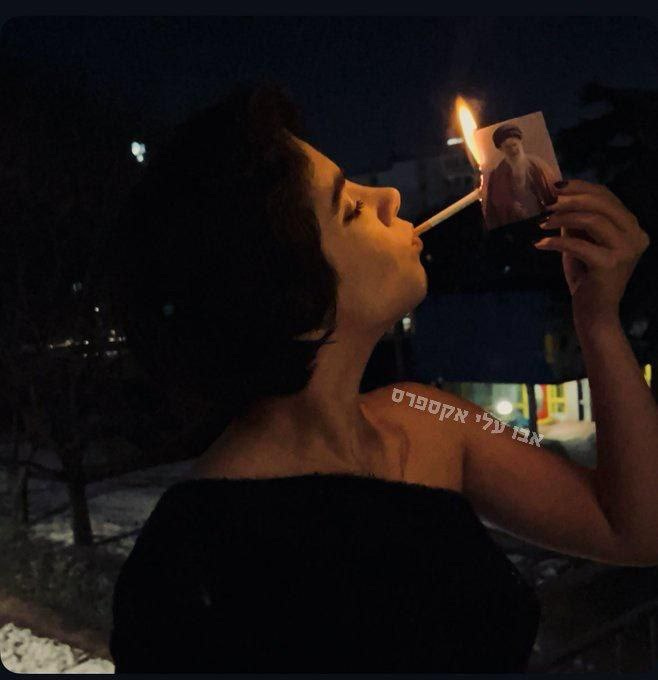
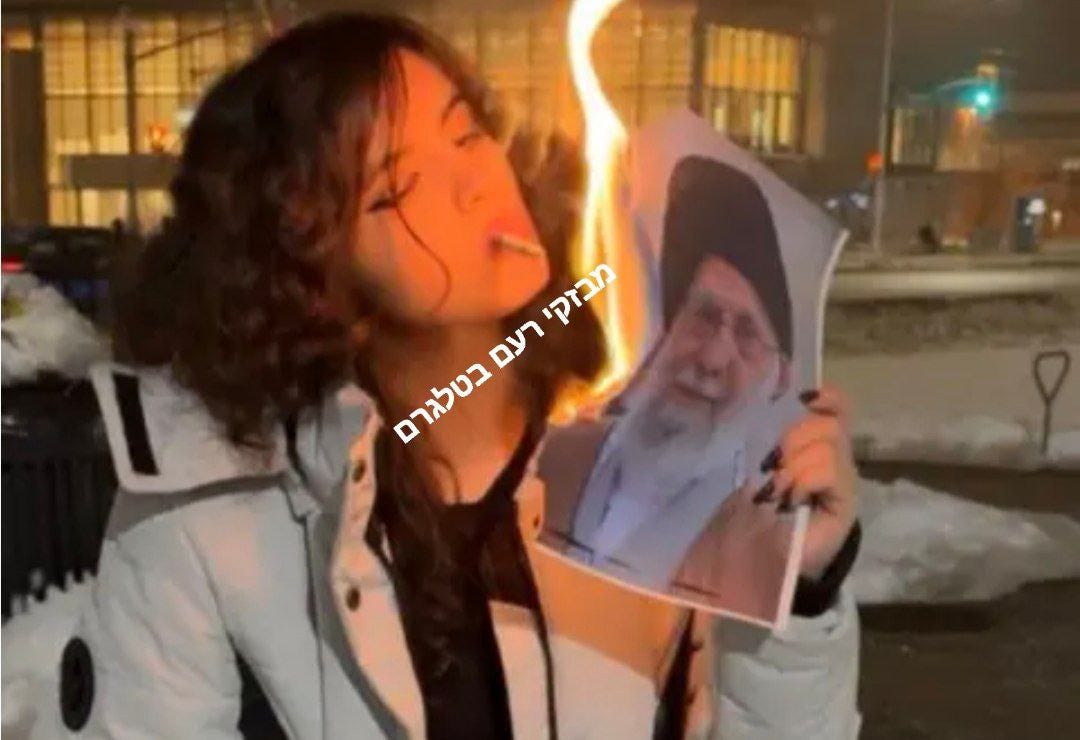
They are women standing bareheaded in the open, lighting a cigarette from the burning image of their dictator. Calm. Defiant. Unafraid. Not pleading, not performing, not asking the world to save them.
This is not protest theatre. This is sovereignty reclaimed.
For decades, the regime taught its people, especially its women, that their obedience was virtue, that silence was wisdom.
The Iranian people were led to believe that they are being oppressed by a powerful regime, and now that lie is being burned in the street, reduced to ash, used as fuel for a moment of quiet contempt.
That image matters.
Because revolutions are not born in crowds shouting slogans. They begin when fear breaks. When a single human being decides that humiliation is no longer an acceptable price for staying alive.
This is not “unrest.” It is not desperation. It is not chaos.
It is moral clarity made visible to the masses.
The king is naked.
And his victims are no longer afraid.
The Iranian lion inhales, lights a cigarette, and lets the tyrant burn.
II. Revolution
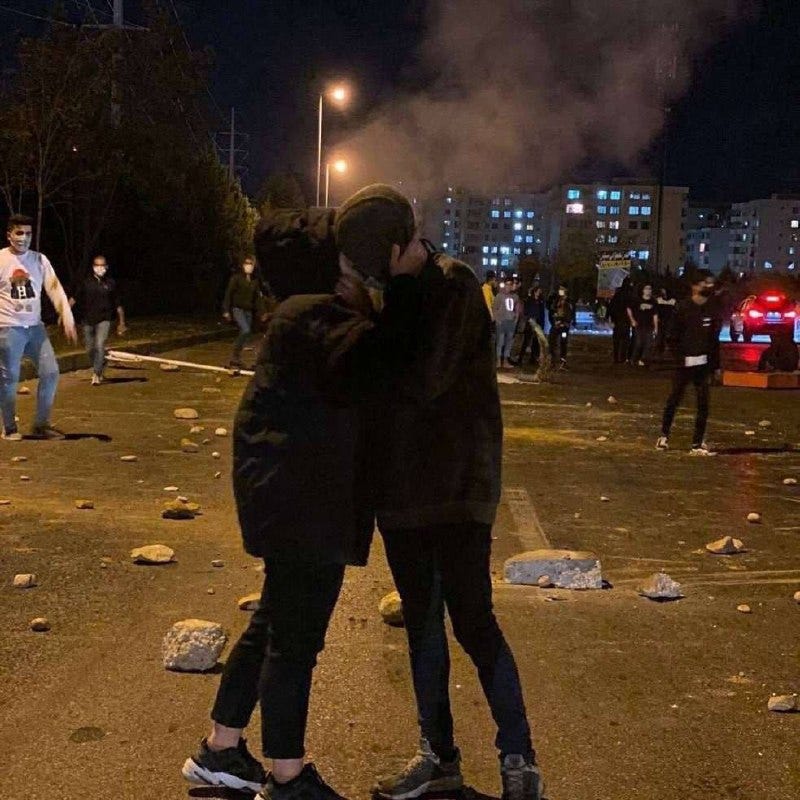
This is not a protest asking for better subsidies, marginal relief, or a kinder version of the same cage.
What is unfolding in Iran is a revolutionary movement, and that is precisely its beauty.
It began where all lies eventually collapse: in the economy. In empty wallets, collapsing currency, bread that costs more each week, lives that no longer add up. People who worked hard, obeyed the rules, kept their heads down, and still found themselves unable to feed their families. And they understood something essential: that this ruin was not accidental. It was chosen.
Chosen by a regime that poured its money into missiles, militias, and nuclear fantasies while its own streets decayed.
That recognition changed everything.
What started as an economic protest did not stay economic for more than a moment. Because once people name the cause of their suffering, they stop negotiating with it. They reject it. The streets were not filled with requests, but with refusal. Millions, across cities and generations, no longer afraid, no longer pretending.
This is a generation that has reached its limit.
It is women who will no longer live with their heads bowed or covered, who step into the open knowing exactly what it costs, and deciding it is worth it. It is men who refuse to work endlessly only to watch their labour finance Hezbollah, Iraqi militias, or wars in Yemen while their own children go hungry. It is the old who remember an Iran before 1979 and know, with painful clarity, what was stolen from them. And it is students who understand that their future does not have to be this narrow, this grey, this suffocating.
They are not asking for permission. They are not drafting demands.
They are burning the symbols of the regime in the streets and standing their ground when the enforcers arrive. They are beating fear itself back, and in doing so, they are exposing the truth that the regime cannot survive: that its power exists only so long as people consent to their own humiliation.
This is not reform.
It is a revolution.
It is a nation deciding that forty-seven years is enough.
III. The Paper Tiger
What the Iranian people are rising against is not their country. It is their country’s occupation.
The Islamic Republic is not an expression of Iranian civilisation. It is its hijacker. A regime that took an ancient nation, rich in culture, memory, and ambition, and reduced it to a staging ground for religious war. It replaced pride with fear, excellence with obedience, and life with martyrdom as policy.
It survives not only through repression but through inversion. Poverty is recast as virtue. Submission is sold as faith. Death is elevated into heroism. And this inversion is exported outward, to Lebanon, Gaza, Iraq, Yemen, turning entire regions into extensions of the same sickness.
In Israel, this has never been misunderstood.
We have known for decades that the enemy was never the Iranian people. We have known that this regime endures not because it represents Iran, but because it has been allowed to. Enabled. Tolerated. Repeatedly rescued by a West too weak to confront evil when confrontation was required.
This regime did not survive because it was sanctioned. It survived because it was sanctioned and then forgiven. Because it was negotiated with, traded with, and legitimised. Because war was postponed in the name of “stability,” and nuclear ambition was treated as a diplomatic puzzle instead of a civilizational threat.
The failure was total.
Worse still, the West did not merely hesitate; it inverted reality. In American universities, the Islamic Revolution is celebrated as righteous resistance. Iran is recast as the oppressed force. Israel, fighting for its survival as a free society, is portrayed as the villain. This moral corruption has spread across Europe and beyond, until clarity itself became suspect and tyranny learned to speak the language of justice.
That is the true depth of Western decay: not ignorance, but confusion elevated into virtue.
And yet, in a bitter irony, it is the people of Iran who now remind the world what moral clarity looks like. Not in conferences or slogans, but in fire and refusal. In the simple, unmistakable act of naming their jailer and rejecting him.
When a people stop mistaking their captor for their country, the regime loses the only thing that ever sustained it.
And that is why this moment is so dangerous for the Islamic Republic, and so hopeful for its good people.
IV. The Opening
History does not offer unlimited chances.
There are moments when pressure accumulates quietly for years, even decades, and then suddenly releases, when fear breaks faster than it can be repaired, when a regime realises, too late, that it no longer controls the tempo of events.
This is such a moment.
For the first time in a long time, the Iranian people are not alone in the open. The United States has spoken clearly. Trump has repeatedly stated that America will not allow the regime to carry out mass slaughter against its own people. Whether that promise will be tested, and whether it will be fully kept, remains to be seen. But the statement itself matters. It shifts psychology. It gives courage to those in the streets, and it terrifies a regime that survives on the assumption that no one will stop it.
That alone is enormous.
Because fear is the regime’s real currency. And for the first time, it is being drained.
Then, in June of last year, came the twelve-day war. And with it, a revelation that cannot be undone. The world saw it, but more importantly, the people of Iran saw it. They saw that the regime they were taught to fear as omnipotent is, in fact, fragile. That the Islamic Republic is a paper tiger. That it is vulnerable, utterly vulnerable, to a country nearly a hundred times smaller than itself.
That knowledge changes everything.
There have been protests in Iran before. There have been large ones, brave ones, costly ones. But this moment is different. Not because the people are angrier, but because the illusion has collapsed. The illusion of invincibility. The illusion of permanence. The illusion that nothing can be done.
Now the people know they are not rising against a god, but against a decaying structure held together by intimidation and habit.
History moves gradually. But when it does, it demands precision, not patience. Half-measures at moments like this are not neutral; they are lethal. Every call for “restraint,” every delay in the name of stability, hands the regime its last remaining weapon: time.
And yet the alignment is unmistakable.
The Iranian people are moving. Israel has long named the threat without illusion. The United States, at least for now, is no longer pretending neutrality between a jailer and his prisoners. These convergences do not linger. They appear, and they vanish.
This is why 2026 feels different.
Not guaranteed. Not ordained. But possible.
And possibility, when history opens the door this wide, carries its own moral demand.
V. Prepare Yourself to Live!
Regimes fall.
That is the truth tyrannies work hardest to conceal, but history never forgets it. No system built on fear, exhaustion, and lies lasts forever. And this one, more than most, is hollowed out from within. Everyone has had enough. The people know it. The regime knows it. The world is beginning to see it.
This is not naïve hope. It is historical realism.
The Islamic Republic is weak because it has nothing left to offer its people. No future. No dignity. No truth. It survives only by intimidation and inertia, and those are brittle foundations. Once they crack, collapse follows quickly.
I hope, above all, that this moment is completed by the Iranian people themselves. That they finish what they have begun. That they reclaim their country without replacing one master with another. But if assistance is needed, I hope Israel will not hesitate. I hope the United States will do what it can. This is not interference with domination. It is in alignment with liberation.
Because this regime is not only Iran’s burden. It is a threat to the entire world, most dangerously through its genocidal ambitions and pursuit of weapons of mass destruction. Ending it is a necessity.
To the people of Iran, this must be said clearly:
You have not suffered for nothing.
Prepare yourself to live!
You were not born for nothing.
Not lived for nothing.
You will rise.
You will rise again, and you will live.
You will live free.
Your young people will live without fear. They will travel, create, argue, love, and build. They will come to Tel Aviv as friends, and we will come to Tehran to celebrate with you what has been denied to you for far too long.
Peace in the Middle East will not come from illusions or slogans. It will come when tyrannies fall, and free peoples meet as equals.
That will be quite the celebration.
To freedom.
To peace.
And to the lion of Iran, rising at last.
All the best!
If you enjoyed Philosophy: I Need It, and want to see more, you can support my work by buying me a coffee. Every contribution makes a real difference. Thank you!
Hopefully, the Iranian people will finally be able to undo the damage the United States did to them in 1953 when we installed the Shah of Iran.
Stirring commentary - well said! And sorely needing to be heard.