

I was about to write about the depressing Israeli election result. I couldn’t quite bring myself to it. Instead, I turned to Bach to soothe my soul, as I often do. Then this recording caught my attention, and I found myself wanting to write about it instead.
I think Bach’s Badinerie ought to be among the most iconic pieces of music ever composed. I doubt many people could hear it without recognising it.
(J. S. Bach, Badinerie, from Orchestral Suite No. 2 in B minor, BWV 1067.)
What far fewer people know is that it’s part of Bach’s Orchestral Suite No. 2 in B minor. Few would know the other movements, and even fewer would know that Gustav Mahler arranged movements from Bach’s Second and Third Orchestral Suites into a glorious 20-minute piece of pure beauty. Almost a little Baroque symphony.
There’s joy, there’s exuberance, and then there’s the sublime Air from the Third Suite, which sounds almost like an adagio from a 19th-century Romantic symphony, composed more than a century earlier. Listen to some of the great Romantic slow movements, like the Adagio from Rachmaninoff’s Second Symphony, and then return to Bach’s Air. Despite the enormous differences in musical language, there’s something remarkably similar in their atmosphere, in that extraordinary sense of sublimity.
And consider the history. I had no idea. This was 1909!
We’re talking about Mahler’s final years in New York City. The very year he composed the Ninth Symphony, some of the darkest, most emotionally draining music he ever wrote. And at roughly the same time, he was working on this Bach orchestral suite arrangement, with, at its very heart, this remarkably joyful one-and-a-half-minute Badinerie, featuring arguably the most famous flute melody in history.
And then there’s the performance history.
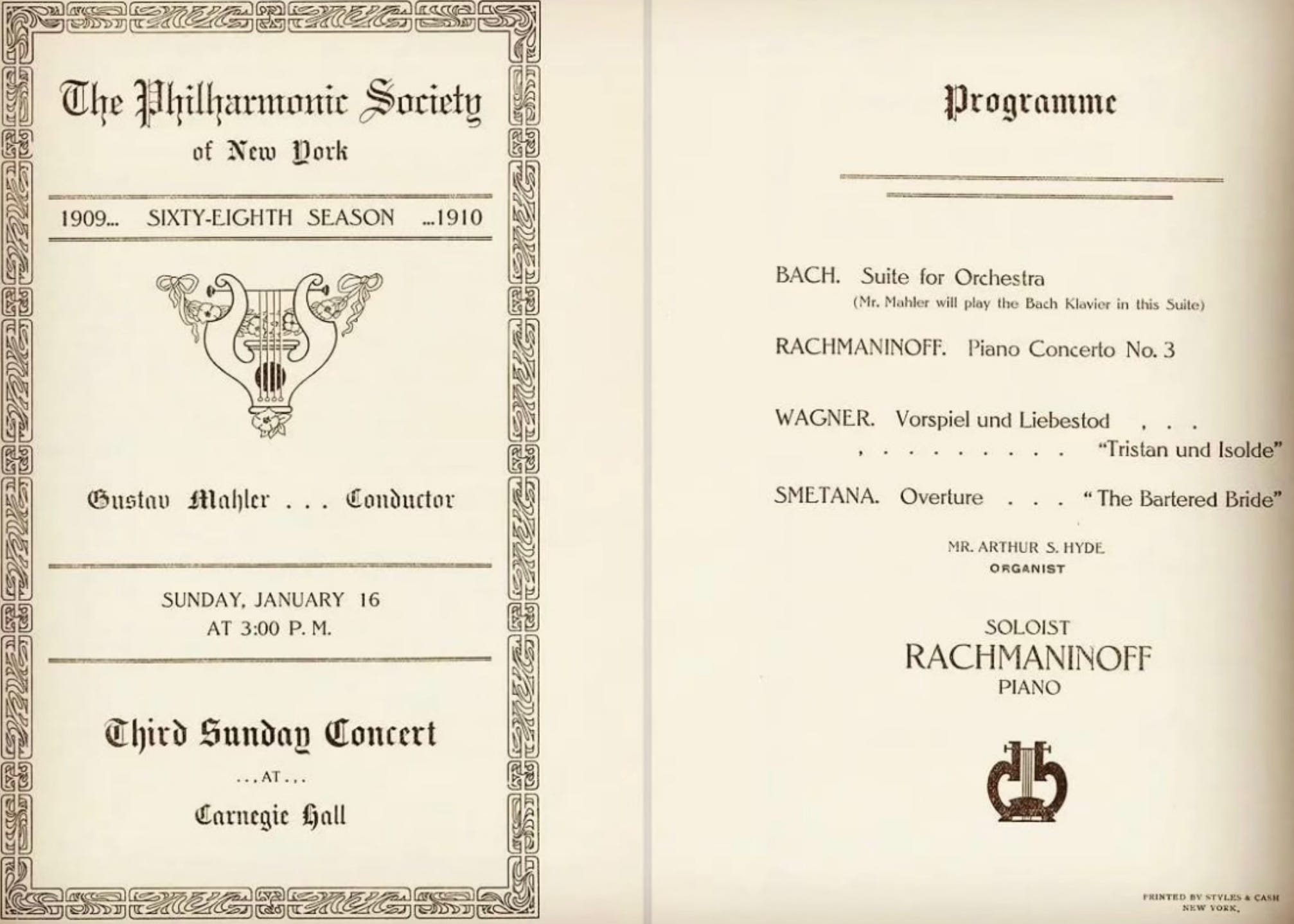
Mahler premiered his arrangement with the New York Philharmonic in November 1909. He himself not only conducted but also played a specially modified piano that imitated the sound of a harpsichord.
Then, on 16 January 1910, he performed it again at Carnegie Hall. And later on that very same programme, none other than Rachmaninoff himself, one of the great epitomes of Romantic music, performed his own Third Piano Concerto, with Mahler conducting!
Just imagine that musical journey, from the sublimity of Bach to the heights of Romanticism, in a single afternoon, under the direction of Mahler himself.
And then some Wagner (Tristan und Isolde, no less!) and Smetana to finish off a Sunday afternoon at Carnegie Hall.
What a day that must have been. What an unbelievable experience.
You have to check this out.
If you enjoyed Philosophy: I Need It and want to see more, you can support my work by buying me a coffee or becoming a monthly supporter.
Every contribution makes a real difference. Thank you!
And if you’re looking for something longer, my debut novella, The Weight of Silence, is available on Amazon. Get your copy here.
Went to see Fatherland last night. People were very slow to move out of their seats at the end…so I don’t think I was the only one searching for a tissue to wipe the tears away.