

I. 1899 Vienna
It is a warm afternoon in Vienna in the summer of 1899. From beyond the Herrengasse comes the bell of a tram; nearer by, the wheels of a carriage pass over the stones. Each time the door of Café Central opens, the noise and heat of the street enter briefly before being absorbed by the vaulted room, its marble tables, dark upholstery, tobacco smoke and low accumulation of voices.
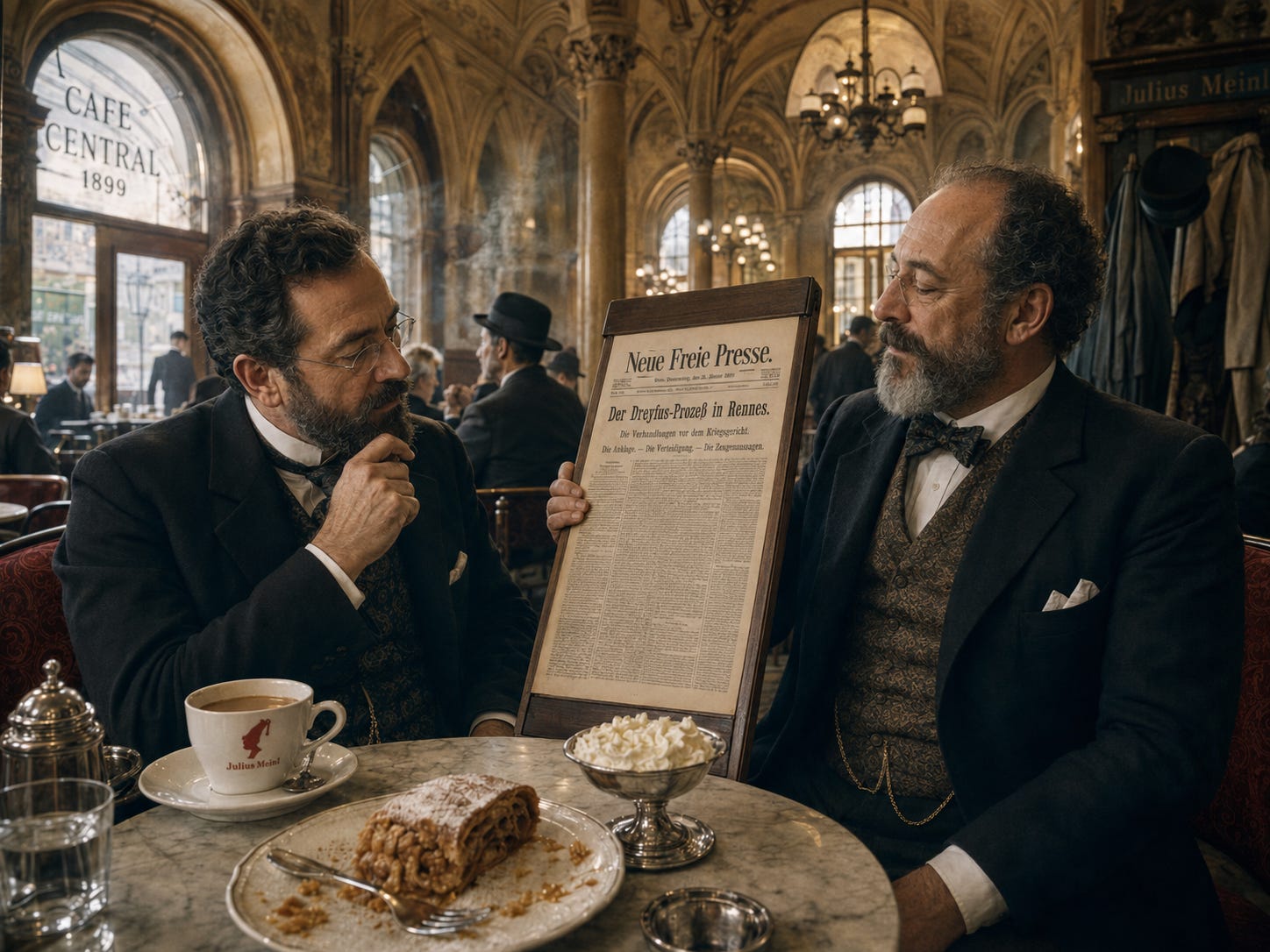
At one table sit two gentlemen in dark coats and high collars. Between them are the remains of an Apfelstrudel, a small silver dish of Schlag and a Verlängerter, untouched for several minutes. One of them holds the Neue Freie Presse open inside the café’s long wooden newspaper holder. They are discussing the trial in Rennes.
The younger man believes that Dreyfus will surely be acquitted. The forged documents have been exposed; Esterhazy has fled; Zola has forced the affair into the open. Whatever the French general staff may wish, he says, the evidence can no longer be evaded.
His companion is not convinced. The evidence is no longer the issue. To acquit Dreyfus, the Army would have to confess not merely that some officers had lied, but also that the honour of the institution had been used to protect the lie. Institutions, he says, do not easily sacrifice their authority to the truth. It’s far simpler to sacrifice the man who has exposed the contradiction.
Their disagreement is conducted in German, with the composure of men accustomed to discussing politics, literature and music over coffee. They belong to Vienna’s Jewish bourgeoisie, although neither would have regarded that fact as a complete or even especially illuminating description of himself. They were Viennese: educated in its schools, formed by its literature, devoted to its music and confident that the culture they served was their own.
The younger man turns the page.
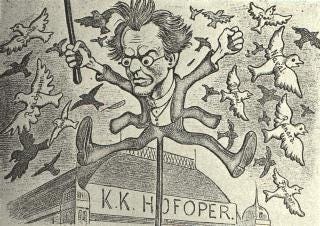
France and Captain Dreyfus disappear behind the wooden frame. In their place is a caricature from Vienna. Gustav Mahler stands like a scarecrow above the Court Opera, his arms raised as the city’s singers scatter from him like startled birds. The caption makes the accusation explicit: “The Jew Mahler as a scarecrow driving away our best singers.” His authority over Vienna’s greatest musical institution is recast as Jewish intrusion.
The younger man studies it for a moment.
“But Mahler was baptised.”
“Two years ago,” says his companion.
“Then why do they still call him a Jew?”
The older man glances at the drawing. “Perhaps baptism is enough for the Opera.”
“But not for the newspaper?”
“Apparently not.”
The younger man looks again at Mahler’s distorted face. He seems perplexed. The contradiction is too obvious. If the objection to Mahler had been his religion, then his conversion should have resolved it. He had accepted the terms placed before him. He had entered the Church, taken command of the imperial opera and devoted his life to Mozart, Beethoven and Wagner. What further demand could be made of him?
The question still assumed that such demands were fulfillable.
These men belonged to a generation of Viennese Jews who had taken the promises of emancipation seriously. They spoke German, read Goethe and believed Schiller that “all men shall be brothers”. They frequented the opera and regarded their participation in European culture not as an imitation of someone else’s civilisation but as their own inheritance. The Enlightenment had offered them citizenship in place of separation: abandon the walls of the ghetto, enter the university, the professions and the arts, and be judged as equal men.
They had believed that their gentile neighbours had accepted the same bargain.
Mahler’s baptism exposed the deception. He could relinquish his religion without relinquishing the identity assigned to him by the antisemites. He could conduct Wagner more magnificently than those who claimed Wagner as their exclusive possession, and this would not prove his belonging. It would make his presence more intolerable. If anything, it would worsen it. The Jew at the margins might be pitied or ignored. The Jew at the podium had to be explained.
The caricature before them was not an isolated vulgarity intruding upon an otherwise enlightened city. By 1899, Vienna had elected and re-elected a politician who understood that such images could be transformed into political power. From his offices in the city hall, Karl Lueger had made the Jew at the podium, the Jew in the newspaper, the Jew in business, and the Jew in the university appear as different faces of the same political enemy.
II. Lueger’s Vienna
The caricature on the café table belonged to more than a prejudice. It belonged to a rebellion against the very civilisation that had made that café possible.
By the end of the nineteenth century, Vienna had travelled far from the old Catholic order. The walls had fallen. The Ringstrasse had risen in their place. Trade, industry and professional life had enlarged the city and disturbed its inherited arrangements. The authority of the Church had weakened; social rank mattered less than education, talent and money; Jews, emancipated in 1867, had entered the universities, the professions, the press, finance and the arts.
Nowhere was their presence more apparent than in the culture of the city. They filled its theatres and concert halls, bought its books and paintings, formed its collections and supported what was new. Stefan Zweig went so far as to write that “nine-tenths of what the world celebrated as Viennese culture” had been “promoted, nourished, or even created by Viennese Jewry.”
Karl Lueger’s Christian Social movement rose against this new Vienna. It drew its programme from Catholic social reform and from the fears of artisans and small shopkeepers who were put at risk of going out of business by industrial production. It promised protectionism, so-called “fair wages” for the workers.
The movement joined these economic ideas to an explicitly Christian politics. Its early programme demanded that Jews be excluded from land ownership, the civil service, the judiciary, the higher ranks of the army, medicine, law and public teaching. Lueger later told a Christian Social audience that the press and high finance had fallen into Jewish hands and that Austria must liberate “Christian people from the hegemony of Jewry”.
Christian Socialism promised Vienna protection from the forces that had made it modern.
The antisemites could enjoy the culture of Jewish Vienna while rebelling against the Jews who had made so much of it possible.
The Jew became the movement’s symbol for the whole modern order it opposed. He appeared as the financier behind capitalism, the liberal behind parliament, the secularist behind the decline of the Church and the critic promoting every disturbing innovation in art. Jewish achievement itself became suspicious: the more successfully Jews entered Viennese life, the easier it became to portray their presence as domination.
The accusations contradicted one another. The Jew could be blamed for capitalism and socialism, for revolutionary agitation and bourgeois complacency, for cosmopolitan rootlessness and secret collective solidarity. Consistency was unnecessary. Each accusation pointed toward the same alleged disruption: the loosening of the old Christian order.
Lueger’s political gift was to transform that abstraction into mass appeal.
He understood the unease of the Viennese artisan and the lower middle class. They were not necessarily destitute. What haunted them was the possibility of descent: the loss of independence, standing and security in a city being reordered by forces they did not control. Lueger approached them with the language of Christian protection. “The little man must be helped” was among its most effective political expressions. It translated conventional Christian ethics into the language of immediate grievance.
And it identified the person against whom the little man required protection.
Zweig saw the method clearly. Lueger, he wrote, taught the usefulness of the antisemitic catchword: it placed an opponent before the eyes of the anxious bourgeoisie and diverted its hatred away from the old landed and feudal wealth. The dissatisfaction remained, but its object had been selected for it.
Lueger could perform this work because he did not resemble the vulgar fanatic. The Viennese called him der schöne Karl. He was good-looking, educated and witty, a gifted speaker who knew how to appeal to a crowd without appearing wholly of it. He understood the value of restraint. The ritual-murder legends and crudest obscenities could be left to lesser men, who might be encouraged when useful and contained when embarrassing.
Perhaps the most famous remark attributed to Lueger was: “I decide who is a Jew.” It captured the flexibility of his antisemitism. Jews served as enemies when the movement required an enemy, while useful or familiar individuals could be exempted from the category. Personal friendship and public incitement could therefore coexist without difficulty. The later Nazis would make Jewishness an inescapable racial condition. Lueger’s method belonged to an earlier stage: he showed how antisemitism could be adjusted to circumstance, made respectable and used in the pursuit of power.
Lueger showed Vienna that hostility toward Jews need not require personal savagery, social disorder or the abandonment of respectable life. It could coexist with certain Jewish friends, cultivated manners, legal institutions and competent administration.
Emperor Franz Joseph actively resisted him. When Lueger was elected mayor, the Emperor refused to confirm the result. Vienna elected him again. The Crown resisted again. But the city continued to return him until imperial opposition gave way, and in 1897 Karl Lueger entered the Rathaus (city hall).
That same year Gustav Mahler entered the Court Opera.
The two men began remaking Vienna at once. From the Rathaus, Lueger expanded municipal authority, modernised public services and established himself as the capable guardian of ordinary Viennese life. At the Opera, Mahler imposed a new discipline upon singers and musicians, transformed the standards of performance and demanded that the institution justify its claim to be the greatest musical theatre in the world.
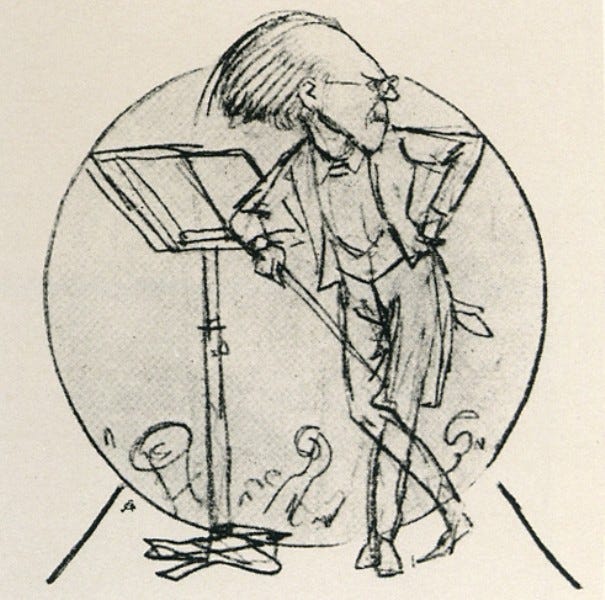
One modernised Vienna by organising its rebellion against modernity. The other modernised its greatest cultural institution as one of modern Vienna’s most conspicuous Jews.
The city accepted the achievements of both.
One evening, Theodor Herzl sat beneath the chandeliers of the Court Opera while Gustav Mahler conducted Wagner’s Tannhäuser.
The orchestra rose beneath Mahler’s hands, and Wagner’s world opened before the house—vast, solemn, irresistible. Herzl listened from the darkened hall. Beyond the doors, Vienna belonged to Karl Lueger.
Wagner, Mahler, Herzl and Lueger converged in that opera house. Wagner supplied the mythology; Mahler brought it to life; Herzl drew from it the force to envision a Jewish state. Outside, Lueger’s Vienna supplied its necessity.
Herzl turned away from the promise of assimilation. Mahler continued to test it, commanding Vienna’s central cultural institution and revealing German music with unmatched authority. Yet his success only made him more conspicuous. The Jew at the margins was accused of refusing to integrate; the Jew at the podium, of taking command.
For ten years, Mahler drove the Court Opera to historic greatness. Vienna accepted the performances while resenting the man who created them.
By 1907, Mahler had had enough. His departure defied a single explanation: the conflicts were institutional and artistic, the exhaustion profound, the personal catastrophes devastating. But he left a city in which ten years of service, conversion and artistic victory had never made his place secure.
He turned toward New York City.
A year later, the young Adolf Hitler arrived in Vienna.
Lueger was still mayor. The lesson awaiting Hitler had already been fully demonstrated. Hatred of the Jew could assemble a mass constituency, survive the objections of the old imperial establishment, triumph at the ballot box and take command of a capital city. It could operate through modern political institutions while preaching rebellion against the civilisation those institutions had produced. It could govern effectively, speak respectably and remain beloved.
Hitler later praised Lueger as the gifted mayor who had “awakened Vienna”. The admiration was especially revealing because he despised so much of the city Lueger governed. Vienna was, in his telling, a “Babylon of races,” crowded with Jews, Slavs, parliamentarians, Marxists and every force he believed was dissolving the German nation.
Mahler departed carrying Vienna’s music toward the New World.
Hitler remained to study its politics.
III. Mahler’s Crossing
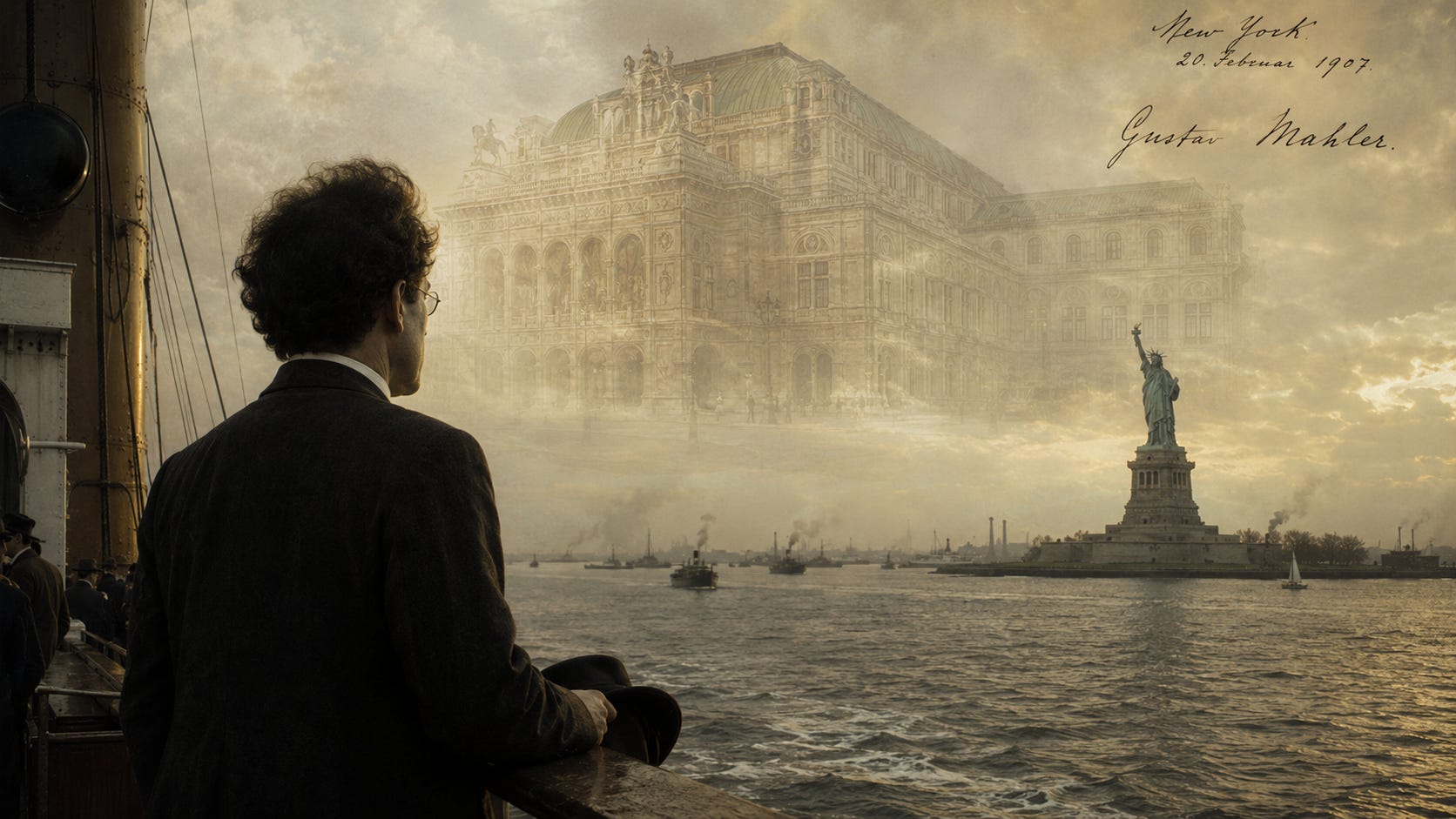
Behind him stood the Opera House he had transformed, the musicians he had driven beyond what was thought possible, and the critics, caricatures and arguments that had consumed ten years of his life. Ahead stood an immense commercial city whose musical ambitions had not yet equalled its wealth.
Mahler did not cross the Atlantic alone. His voyage coincided with one of the great Jewish migrations into New York. He travelled with a baton and partituras; most around him carried families, trades and whatever they had managed to take out of Europe. The city ahead of them was still being made.
Mahler entered New York through the Metropolitan Opera. In 1909, he took charge of the New York Philharmonic.
The musicians before him did not belong to an entirely foreign world. German immigrants and their descendants filled New York’s orchestras, conservatories and musical societies. German was enough in the rehearsal room; Mahler never needed to master English to command them. The old world had crossed before him.
He began remaking the Philharmonic as he had remade the Court Opera. Players disappeared from the roster. Others were summoned from Europe and orchestras across America. The season expanded. Rehearsals intensified. New York had acquired the conductor Vienna had exhausted.
In the summers between his New York seasons, Mahler returned to Austria, to Toblach in the South Tyrolean Dolomites, where, in a small composing hut among the mountains, he wrote his last completed symphony, the Ninth.
The old city remains inside it. In the second movement, the Viennese dance returns without its ease. The Ländler stamps, lurches and loses its footing; the gestures survive after their warmth has departed. The dance works itself into a frenzy and ends among spectral fragments, as though Vienna were trying to remember its own movement after the dancers had gone.
Then comes the Rondo-Burleske.
The voices pursue one another with furious precision. They interrupt, mock and crowd each other, every line sustaining its own attack while joining the movement’s relentless course. What first sounds like chaos reveals itself as a feat of controlled counterpoint. The inferno takes the form of a fugue.
It sounds like a demand that renews itself after every concession. One accusation enters, then another, then another—distinct, relentless and all directed toward the same end. Nothing escapes the structure. The hostility proceeds under discipline.
It sounds like Vienna.
For a moment, the movement opens into tenderness. Another world appears, distant and vulnerable. Then the machinery returns.
New York offered no clean escape from Europe. German sounded in its rehearsal rooms and Yiddish in its streets. Yet here the inherited world was being broken apart and rearranged by those who had crossed the ocean. Origin remained a memory rather than a sentence.
Mahler lived only briefly in New York. He died in 1911, before he could hear the Ninth performed and before the city around him had reached the height of its transformation. Those who had crossed beside him remained, and New York continued to tower around them.
Mahler left a Vienna transformed by its Jews and arrived in a New York they were still transforming.
He crossed the Atlantic believing that New York represented the future.
He could not have imagined that Vienna’s politics would one day follow him there.
IV. 2026 New York
Jewish life in New York began in 1654, when a small group fleeing the Portuguese Inquisition arrived in New Amsterdam. By the beginning of the twentieth century, the harbour was receiving Jews by the hundreds of thousands from Russia, Galicia, Poland, Hungary and the old Habsburg lands. Their descendants entered the garment trade, Wall Street, Broadway, journalism and the universities. They founded businesses, endowed hospitals, filled concert halls and built institutions intended to survive them. In doing so, they made New York the vibrant centre of the Jewish world.
Today, nearly one million Jews live in New York—about one resident in nine, a proportion strikingly close to that of Vienna in the old days. In both cities, a minority comprising roughly a tenth of the population became central to the commercial, intellectual and cultural life of the whole.
Jewish names appear on hospital wings, university halls, libraries, museums and endowed chairs throughout New York. Jacob Schiff gave $500,000 for the construction of Students Hall, later Barnard Hall, even as he protested Columbia’s refusal to appoint a Jew to its board of trustees. He stipulated that the building should favour no religious group.
After his death, a proposal to name the hall after him was rejected. Schiff had paid for the building, but his name could not appear on its façade. He was one of many Jewish New Yorkers who continued to give, build and endow institutions from which Jews themselves had not always been fully accepted.
A century later, the institutions sustained by that faith supplied the stages, prestige and vocabulary of a movement now directed against them.
After the greatest mass murder of Jews since the Holocaust, October 7, university quads across New York filled with encampments and demonstrations in support of the murderers.
Theories of liberation, resistance, and colonial justice almost instantly absorbed the mass murder of Jews. The looters/rapists/murderers who broke through the border to massacre families were portrayed as heroic fighters of the oppressed, while the state and its soldiers trying to defend its citizens were labelled as a genocidal mega-villain. The institutions funded in the spirit of emancipation became centres from which Jewish independence was declared illegitimate.
Vienna’s Jewish bourgeoisie had patronised the culture that learned to exclude them. Jewish New York endowed the universities that taught a new generation how to place them in the dock.
The language had changed. The moral inversion remained the same.
Hatred of Jews has always attached itself to whatever the Jews are seen to have done well. When they traded, they were exploiters. When they lent money, they were parasites. When they entered the professions, they were infiltrators. When they succeeded, their success was proof that someone else had been cheated. The vocabulary changes with the century. The accusation does not. Finance becomes global capital. The wealthy Jew becomes the privileged coloniser. Antisemitism becomes anti-Zionism. The moral charge remains fixed: acquisition, strength, independence and self-determination belong to the oppressor.
Zohran Mamdani rose in the city where those qualities had produced their greatest urban monument.
He looked upon New York—the skyline that is capitalism made visible, every tower a monument to the premise that private ambition can raise stone and steel higher than any state—and offered communism as its rescue.
The total inversion of the city’s founding principle, proposed from inside the city itself. Rents would be frozen. Buses would become free. Grocery stores would be operated by city hall. Childcare would become a universal entitlement. Corporations and the wealthy would supply the money. Billionaires, Mamdani declared, should not exist.
The programme depends on the city continuing to produce the wealth it condemns. Wall Street must remain profitable enough to be taxed. Businesses must continue operating beneath regulations that punish their success. The ambitious must remain in New York while being told that their ambition created the injustice from which the city will save everyone else.
Lueger offered Vienna the same bargain in Christian language. The city could keep the culture, prosperity and public services of modernity while revolting against the liberal principles that had made them possible. Mamdani offers New York its capitalist abundance, but without the system that made this abudance possible.
In both cities, the Jew represents the perfect target.
Jewish New York represents the success of the immigrant who arrived with nothing, entered commerce, built institutions and refused to remain confined by the status assigned to him elsewhere. Israel represents the same achievement in political form. A persecuted people acquired sovereignty, built a prosperous economy, defended itself and ceased to depend upon the goodwill of other nations for permission to survive.
To the anti-capitalist mind, success is proof that the successful exploits the unsuccessful. The factory owner exploits the poor worker; therefore, the owner is evil, and the suffering workers are good. Same with Israel: Israel’s success is proof that they are exploiting the poor Palestinians; therefore, Israel = evil, Palestine = good.
Prosperity becomes privilege. Independence becomes exploitation. Military strength becomes colonisation. The refusal to remain a victim becomes proof that the former victim has changed places with his persecutor. The Jew may be pitied in the ghetto, mourned in the grave and commemorated in the museum. The Jew who owns, builds, commands and defends himself presents a different problem.
Anti-Zionism, antisemitism and anti-capitalism are not three convictions. They are one conviction in three variations. Israel concentrates in one country everything Mamdani’s moral system treats as immoral: private wealth, technological achievement, national self-assertion, military power and an unapologetic determination to prosper. It is a standing refutation to his perverted worldview.
His reaction to October 7 exposed that explicitly.
On October 8, Mamdani issued a statement mourning those killed “across Israel and Palestine.” He turned immediately to occupation, apartheid and the actions of the Israeli government. Hamas went unnamed. The massacre appeared chiefly as another stage in a structure for which Jewish power bore the ultimate guilt.
That did not emerge from ignorance or confusion. Mamdani grew up in an intellectual household. His father, Mahmood Mamdani, is a Columbia professor whose career has centred upon colonialism, political identity and the postcolonial state. Zohran Mamdani learned the vocabulary through which violence is assigned moral meaning: coloniser and colonised, oppressor and oppressed, resistance and liberation.
He speaks carefully because he understands the ideas.
The universities had spent years teaching students to divide the world into groups defined by power. October 7 furnished the perfect test of that education. Jews had been massacred, yet Israel possessed a state, an army and a successful economy. Within the hierarchy of oppression, Jewish strength outweighed Jewish suffering. Sympathy moved away from the murdered and toward those who murdered them.
The ensuing demonstrations created the climate in which Mamdani’s record became a political asset. Hostility toward Israel became evidence of independence, integrity and courage.
He refused to sign a resolution congratulating Israel on its seventy-seventh anniversary. On Holocaust Remembrance Day he declined to co-sponsor the resolution memorialising that date. As mayor, he told ABC he could not say he supported Israel as a Jewish state.
Lueger made antisemitism respectable by attaching it to Christian social concern — his discovery in another vocabulary. Mamdani attaches it to anti-colonial justice. Lueger spoke for the threatened Catholic artisan against Jewish capital and liberal modernity. Mamdani speaks for the tenant, the worker and the colonised against billionaires, capitalism and Zionism. Both systems gather diffuse resentments, provide them a moral veneer, and direct them toward the Jew as the proxy for illegitimate power.
In a recent video viewed more than one hundred million times, he called Benjamin Netanyahu a “war criminal” and “the architect of a horrific genocide against the Palestinian people.” To apply the word ‘genocide’ to the Jewish state, to take the term naming the supreme crime committed against the Jews and turn it into a weapon against Jewish self-defence, is not error, exaggeration, or rhetorical excess. It is evil. Plainly evil. It takes the memory of six million murdered Jews and conscripts it into the cause of those who wish to see the Jewish state destroyed. One hundred million people watched a representative of the most Jewish city in America perform that act of moral inversion, speaking with the authority of office and the confidence of a man announcing a truth that others supposedly lacked the courage to say.
Its reach was significant. Its function was not diplomatic. It made the targeting of Jews into a mark of political courage. The speaker stood against a phantom power and invited one hundred million people to share the thrill of defiance.
Lueger’s speeches performed the same political work. The enemy was presented as powerful enough to explain the public’s suffering and weak enough to be attacked without consequence. Resentment dressed itself as resistance.
New York’s establishment accommodated Mamdani because he spoke its language. Universities, cultural institutions, and the press had already partitioned humanity into the roles of oppressor and oppressed. They had already learned to treat capitalism as exploitation and Zionism as colonialism. The old-fashioned antisemite would have offended their manners. Mamdani carried the prejudice in terms they had taught themselves to respect.
Lueger said: “I decide who is a Jew.” Mamdani’s Jewish supporters in New York perform the same operation from the other direction. They decide that they are not the Jews being targeted. The hostility is aimed at some other kind of Jew: the Zionist, the settler, the one who insists on Jewish power rather than Jewish suffering. They stand beside Mamdani as proof that his politics cannot be antisemitic, because here they are, Jews, and they are not offended. Lueger kept Jewish friends for the same reason. The exemption served the programme. It demonstrated that the movement’s hostility was not indiscriminate but principled, directed only at those Jews who deserved it. In both cases the willing Jew does not refute the antisemitism. He completes it.
Karl Lueger exploited antisemitism before Auschwitz.
He belonged to a world that had not yet seen the Holocaust or the horrors of socialism and communism. He was an opportunist, capable of friendship with individual Jews, exploiting a prejudice whose final destination remained hidden from him.
Mamdani has no such darkness ahead of him.
The Holocaust lies behind him. October 7 occurred in his own political life. The collapse and mass death of the communist century belong to the settled history of his world. He inherits the record of both hatreds: the Jew as the source of social suffering and the sacrifice of individual ambition to the collective need. Lueger was not the man who lit the match before anyone knew what fire could do. Mamdani is the man who saw the ashes and struck another.
He chooses both.
Lueger drew upon the old Christian resentment of Jewish modernity. Mamdani draws upon the intellectual systems produced by the modern university (much of which was funded by America’s wealthiest Jews). His antisemitism arrives educated, theoretically armed and fluent in the language of human rights. It denies Jewish nationhood while proclaiming universal equality, excuses violence as resistance while mourning civilians, and attacks the Jewish state while disclaiming all hostility toward Jews.
The sophistication deepens the guilt.
One consolation remains. A mayor of New York possesses little power over Israel. He possesses considerably more power over New York. His communist domestic programme, with its frozen rents and municipal grocery stores and war on private wealth, may prove so destructive to the city that his anti-Israel obsession becomes the lesser danger. That this constitutes a silver lining reveals the city’s decline: a metropolis whose best hope is that a leader’s hatred of the Jewish state will prove less destructive than his plans for the city itself.
The city those immigrants built has now elevated a leader who condemns the economic system that allowed them to build it and the Jewish state that ensured their people would never again live at the mercy of others.
Lueger’s most consequential pupil was not yet a dictator when he arrived in Vienna. He was a young man without settled politics, absorbing the movements around him and watching to see what brought a politician from the margins into power. Lueger taught him that antisemitism could gather resentment, give it direction and carry its practitioner into the heart of government.
New York’s universities now house activists who celebrated October 7, excused murder as resistance, and learned to articulate hatred in the language of justice. They are watching Mamdani rise. They see that antisemitism, properly disguised, does not end a political career. It can create one.
Lueger showed a young Hitler the road to power. What is Mamdani’s New York teaching the person watching now?
Epilogue
But the café is still warm, and the afternoon is not yet over.
The younger man sets down the paper. Through the window the Ringstrasse catches the last of the light. Carriages pass beneath the lindens. A waiter crosses the marble floor with a fresh Verlängerter on a small silver tray, the spoon resting beside it at a precise angle, and places it without a word between the two men. Somewhere beyond the inner courtyard a pianist is practising Schubert, the same phrase repeated and corrected, repeated and corrected, each attempt a little closer to what the music requires.
The older man stirs his coffee. He is thinking about the second act of Don Giovanni, which he will attend on Saturday. He has been told the new tenor is exceptional. He looks forward to telling his companion about it on Monday, here, at this table.
The younger man turns the caricature face down. For now it is only a drawing in a newspaper. The lindens are still green. The coffee is still good. The music across the courtyard reaches the phrase it has been looking for, holds it, and carries it outward, past the courtyard walls, past the Ringstrasse, past the spires and the river and the blue hills beyond Vienna, into the open sky where it will go on, fading and not fading, forever.
If you enjoyed Philosophy: I Need It and want to see more, you can support my work by buying me a coffee or becoming a monthly supporter.
Every contribution makes a real difference. Thank you!
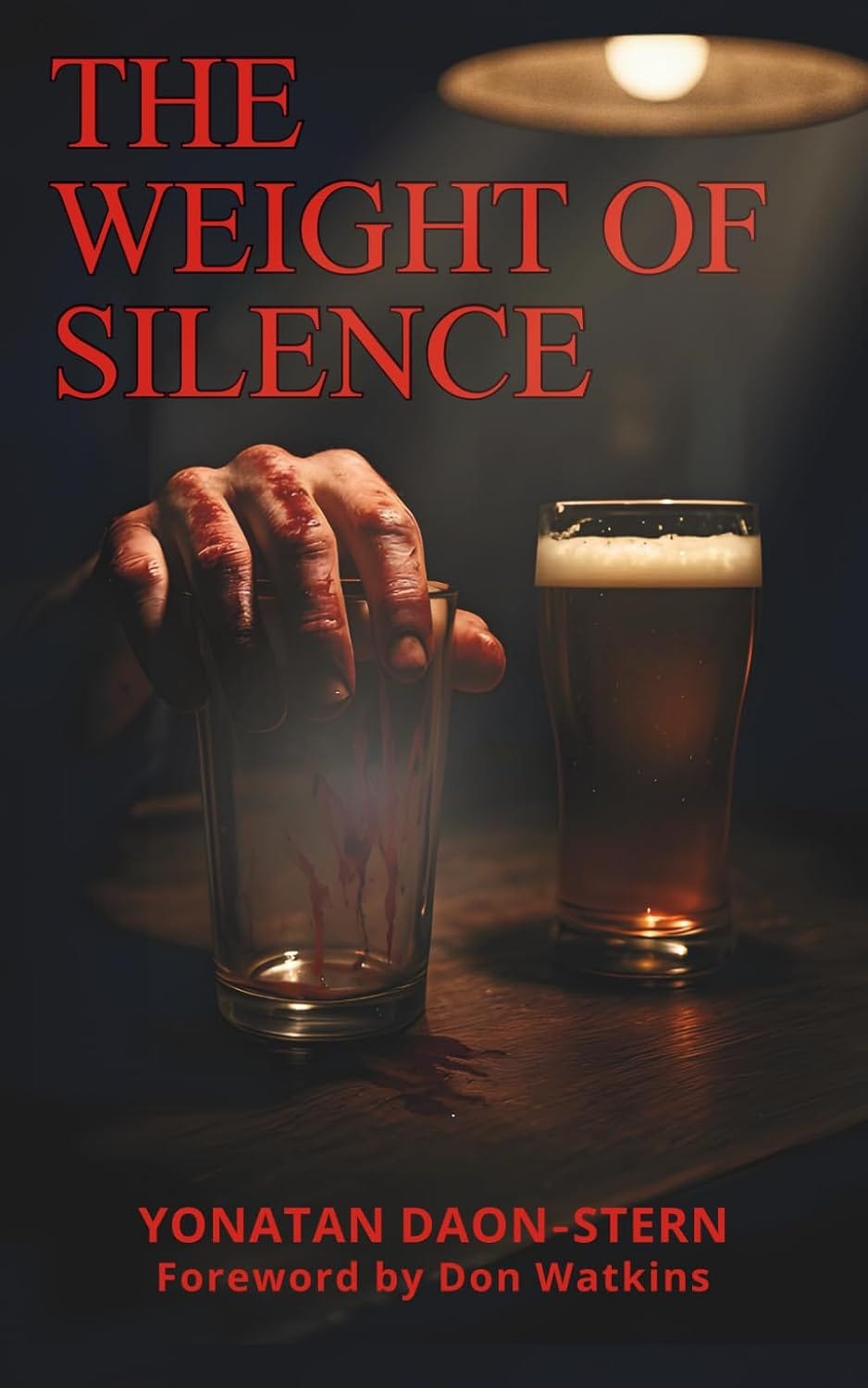
And if you’re looking for something longer, my debut novella, The Weight of Silence, is available on Amazon. Get your copy here.
This article borders on brilliance. May I suggest: rewrite this piece, de-emphasizing (but not eliminating) the references to Mahler and bringing Mamdani to the forefront earlier in the essay. Lueger's statement says it all: "I decide who is a Jew."
Your analysis is excellent, but I am still left with the inexplicable source of anti-Semitism. As you say: "Anti-Zionism, antisemitism and anti-capitalism are not three convictions. They are one conviction in three variations." Yes, and they all seem to stem from one main source: envy. What I do not understand is, how can such a discredited depravity be so powerful?