

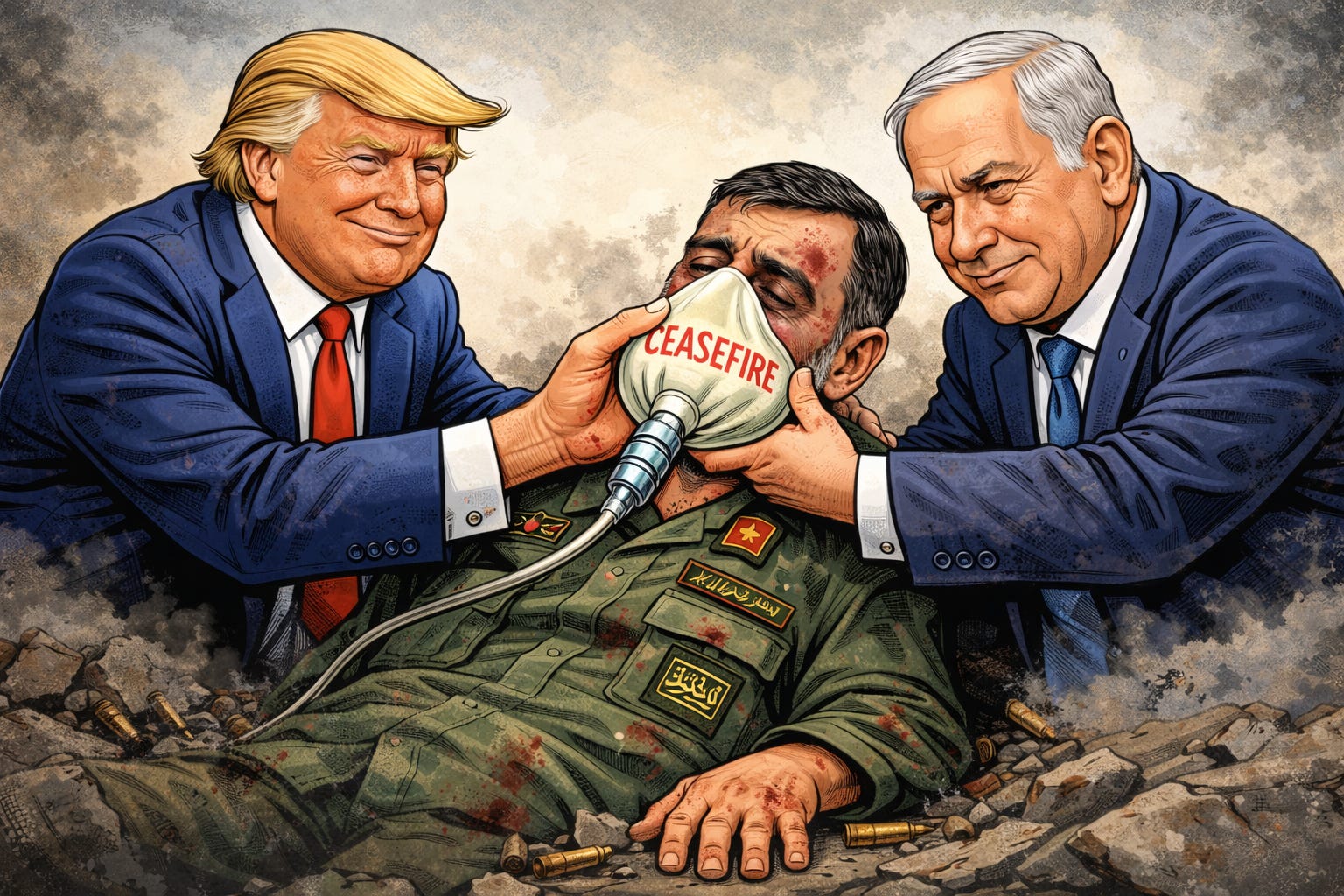
Today victory was celebrated in Tehran.
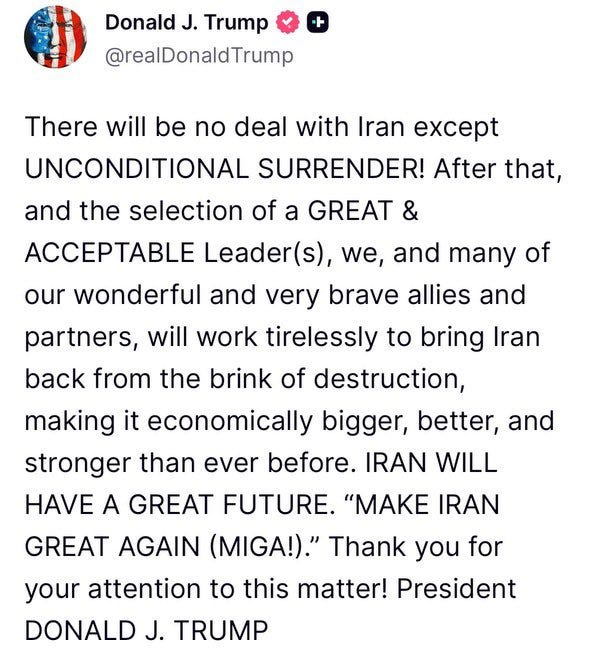
That is the image one must begin with. Less than a year ago, in June 2025, Trump was demanding Iran’s unconditional surrender. Here we are now, for the second time, with something much closer to the unconditional surrender of victory by the West itself.
That is the image one must begin with, because it shatters all the euphemisms at once. Not the tweets from DC. Not the grotesque self-congratulations about “peace”. Not the vocabulary of de-escalation, stabilisation, exit strategies, and all the other cowardices by which the West disguises its fear of victory.
The celebrations.
Because these celebrations tell the truth.
A regime does not celebrate when it has been defeated. It celebrates when it has survived, when the blows stop short of the final one.
That is what happened here.
The Iranian regime was wounded, exposed, and shaken. Its aura of invulnerability had been punctured, its leadership thinned, its weakness dragged into the open.
And then, exactly then, came the ceasefire.
No, not a “temporary ceasefire”. This was not a “temporary ceasefire”; it was a ceasefire, which is to say a halt before victory, wrapped in phrasing designed to make the halt sound smaller, softer, and more sophisticated than it was.
In reality, it was a rescue.
Trump’s rescue for the ayatollahs. Trump’s rescue for the IRGC. Trump’s rescue for the mullah regime at the very threshold of their defeat.
And the language he used to announce it was almost too perfect, too revealing in its vulgarity. Everything was “complete”, “immediate”, “safe”, “definitive”, “long-term peace”, and “met and exceeded”. He does not merely boast. He renames. He takes surrender and calls it victory, interruption and calls it peace, an unfinished war and calls it resolution. He declares success in order to avoid having to achieve it.
This is not statesmanship. It is Newspeak.
Nor is it new. We saw this with Iran last June as well: force, then hesitation, then the renaming of incompletion as success. This is not an anomaly. It is the method.
And yet the sickness does not end in Washington. There is another form of it, smaller, pettier, but no less corrupt, and it is spreading through the Israeli reaction as well. One sees videos from Tehran, motorcycles, celebrations, and cheering in the streets, and instead of asking the only serious question, why are they celebrating, one is told this is “the battle over the narrative.” The narrative. As though war were a seminar in media studies and the regime’s jubilation only one interpretation among many.
No. This is not a narrative. It is evidence.
The problem is not that Iran is shaping the narrative. The problem is that we are refusing to describe reality.
A regime like this does not judge victory the way ‘experts’ do. It does not ask how much steel output was lost, how many factories were hit, how many installations were damaged, or whether the enemy can produce a pleasing spreadsheet of physical destruction. It asks cruder, simpler, more decisive questions: Are we still in power? Are we still ruling? Did the enemy stop? Will we live to reorganise, repress, replenish, and fight again?
If the answer is yes, then their celebration is absolutely justified.
That is what is unbearable to admit. The regime may be bloodied, humiliated, and damaged for years. But if it remains standing, sovereign over its terror machinery and still master of the threat, it has not been defeated. It has been spared.
We have seen this before. In fact, the most nauseating feature of the whole affair is how familiar it is. We saw it in Gaza. We saw it in Lebanon. We saw it in Israel’s endless parade of half-wars and half-victories. We saw the enemy celebrate then, too. We saw Hamas march in the streets one ‘deal’ after another, and every time the public was told not to believe what it saw. “It is only for show.” “It is only psychological warfare.” “They are controlling the narrative.”
No. They were responding to reality. The lie was not in the celebration. The lie was in what we were told afterwards.
And Hezbollah stands before us as the great monument to this lie. Hezbollah is what a ceasefire looks like a year later. It survived because it was allowed to survive. It rearmed because it was allowed to rearm. It became a permanent strategic nightmare because wars that should have ended in destruction ended instead in arrangements, understandings, pauses, and the other euphemisms of frightened civilisations. Now, with Iran, we are repeating the same mistake on a larger scale, with higher stakes, and under a greater illusion.
So let us strip the matter down to its bones.
If the regime remains, this is not victory.
If the source of the threat remains, this is not victory.
If the enemy can regroup, restore its chain of command, and resume the war at a time of its choosing, this is not victory.
If the war had to stop before the threat was politically broken, then this is not peace. It is a rescue.
That word matters. Rescue. Because it says what all the nicer words are trying to hide. This was not some tragic compromise reached after triumph. It was the active political salvation of a regime that had not yet been pushed far enough.
And it is not enough to lay this at Trump’s feet alone. Netanyahu chose to go along with the rescue.
Yes, Israel is smaller. Yes, Israel has done extraordinary things in this war. Yes, the achievements of Israeli intelligence, military daring, operational penetration, and national resilience have been astonishing. That is precisely what makes this so contemptible. Israel generated momentum. Israel created leverage. Israel opened a possibility that had seemed almost unimaginable. And then, once again, the political meaning of that achievement was handed over to American timidity and accepted by an Israeli government that has spent years teaching its citizens to live inside an infinite war.
Netanyahu’s record, taken as a whole, is one long education in incompletion: enemies left standing, rounds of war without finality, temporary arrangements elevated into strategic doctrine, and a public expected to confuse the mere continuity of life with actual safety. I do not trust the long-term future of Israel to men who keep stopping short and calling the result prudence.
And beneath all of this lies the real issue, the one larger than Trump, larger than Netanyahu, larger even than this particular ceasefire.
The West does not know how to win.
Not because it is weak in arms, technology, intelligence, or force. It has all of that in abundance. What it lacks is moral clarity. It no longer begins war by asking, what does victory look like? It begins by asking, how do we get out? It seeks an ‘exit strategy’ before it has even defined a victory condition. It worries about the off-ramp before it has decided whether the enemy deserves a cliff.
A moral civilisation asks, ‘What would victory require?’
A degenerate one asks, ‘How do we leave?’
Trump did not lack an exit strategy. The ceasefire was the exit strategy.
The problem was never that these people did not know how to stop. The problem was that they were always preparing to stop. The language of so-called peace, the frantic declarations of accomplishments, and the insistence that everything essential had already been achieved—all of it was the rhetoric of men who had decided in advance that completion was too demanding, too dangerous, and too morally strenuous for them to bear.
There is, of course, one possible exception, one final possibility under which all this might someday look less disgraceful than it appears now. If this ceasefire were truly part of a deeper strategy to trigger or exploit an internal revolution in Iran, then judgment would have to be suspended. If the ceasefire were the pause before implosion, the lull before the regime’s own people finished what outside force had begun, then perhaps one could speak differently.
But I do not believe it.
I do not believe that a leadership incapable of finishing the obvious task of securing the Straits of Hormuz is secretly conducting a subtler masterstroke behind the curtain. The simpler explanation is the true one. They wanted out.
Yes, it could have been worse. Yes, under different leadership the war might never have begun at all. Yes, history may in some bitter sense have been fortunate that the task fell not to people even softer, even more evasive, even more addicted to paralysis. Fine. Grant all of that. It changes nothing essential. Better than immediate surrender is still no substitute for victory. We were lucky enough to have leaders willing to begin the war and unlucky enough to have leaders too weak to finish it.
And now the consequences begin to spread.
This rescue will not remain confined to Tehran. It will echo across the region. Every Islamist movement will draw the same lesson: survive, endure, wait for the West to lose its nerve, and live to fight again. It will embolden proxies and encourage anti-Western forces everywhere. The message is simple: the West can hit hard, but it no longer knows how to finish the job. Iran is the strategic disaster. Lebanon may become the immediate one if the same pressure for a ceasefire is now turned northward.
And so we arrive at the most humiliating thought of all: that our best hope may be the enemy’s own nature. That they will violate the ceasefire, overplay their hand, and, by remaining true to themselves, force us to recover our own clarity. Such is the depth of our confusion that we begin to hope the enemy will save us from ourselves.
When a society loses the will to victory, it begins to depend on the enemy’s recklessness to restore its own clarity.
That is where we are.
And so we return to Tehran, because that is where the truth was visible from the start.
They were celebrating.
They were not wrong.
They understood that they had survived, that the war had been halted before the final consequence was imposed, and that the stronger side had lost its nerve. They understood that the West still fears victory more than they fear defeat and that all they have to do is endure until that fear reasserts itself. They understood, in other words, exactly what happened.
They were rescued.
If you enjoyed Philosophy: I Need It, and want to see more, you can support my work by buying me a coffee. Every contribution makes a real difference. Thank you!
Thank you for saying so eloquently what I’ve been thinking. This is a sad day for America, for Israel, for the Iranian people who want freedom, and for anyone who prefers western civilization over Islamic repression. All that time, treasure, hard work and genius of our American and Israeli militaries and pilots…for what?? I’m heartbroken.
So, so depressing.