

A state exists to protect the rights of its citizens. That is its purpose. That is its only moral justification. If it does that, it has legitimacy. If it does not, its legitimacy is compromised, no matter how opulent it is, no matter how many monuments to vanity it builds, no matter how many Western fools it dazzles with its staged modernity.
That is the standard by which a state should be judged: protecting the rights of its citizens. Everything else is secondary. If a regime permits outside forces to threaten, bombard, and terrorise its civilians without paying any price, then it is not merely failing at one policy task. It contradicts the very reason states were formed in the first place. A state that will not defend its people ceases, in the deepest moral sense, to be a state at all.
Israel and the United States have unequivocally acted on that principle with extraordinary success. The US and Israel have shown the world that they take their self-defence seriously, are willing to act on it, and possess the competence and moral clarity to act decisively.
Since February 28, Israel and the US have eliminated the upper echelon of the Iranian regime and many thousands of its soldiers and officers. They have destroyed its navy, its air force, and its air defences. Its nuclear and ballistic missile programmes have been devastated. The Israelis’ and Americans' overwhelming display of strength and determination has shattered much of the Islamic Republic’s project to destroy Israel and assert dominance over the Middle East.
Iran has been exposed as fundamentally vulnerable: a regime whose airspace can be penetrated, whose leadership can be decapitated, and whose military prestige has collapsed within days. But Iran is not the only Middle Eastern actor this war has exposed. There is another, and it is not one state but many.
For weeks, the Gulf has been under direct bombardment. Iran's missiles and drones have struck city after city, hitting airports, harbours, energy infrastructure, hotels, homes, and commercial districts. The names Dubai, Abu Dhabi, and Doha evoke opulence, commerce, and global confidence. In this war, they have come to mean something else as well—fire, fear, damage, death.
These cities were built as monuments to luxury, stability, and global prestige. For weeks now, they have looked like something else entirely: frightened, burning, exposed. The illusion of immunity has collapsed.
And what do these regimes do in the face of their destruction?
Nothing.
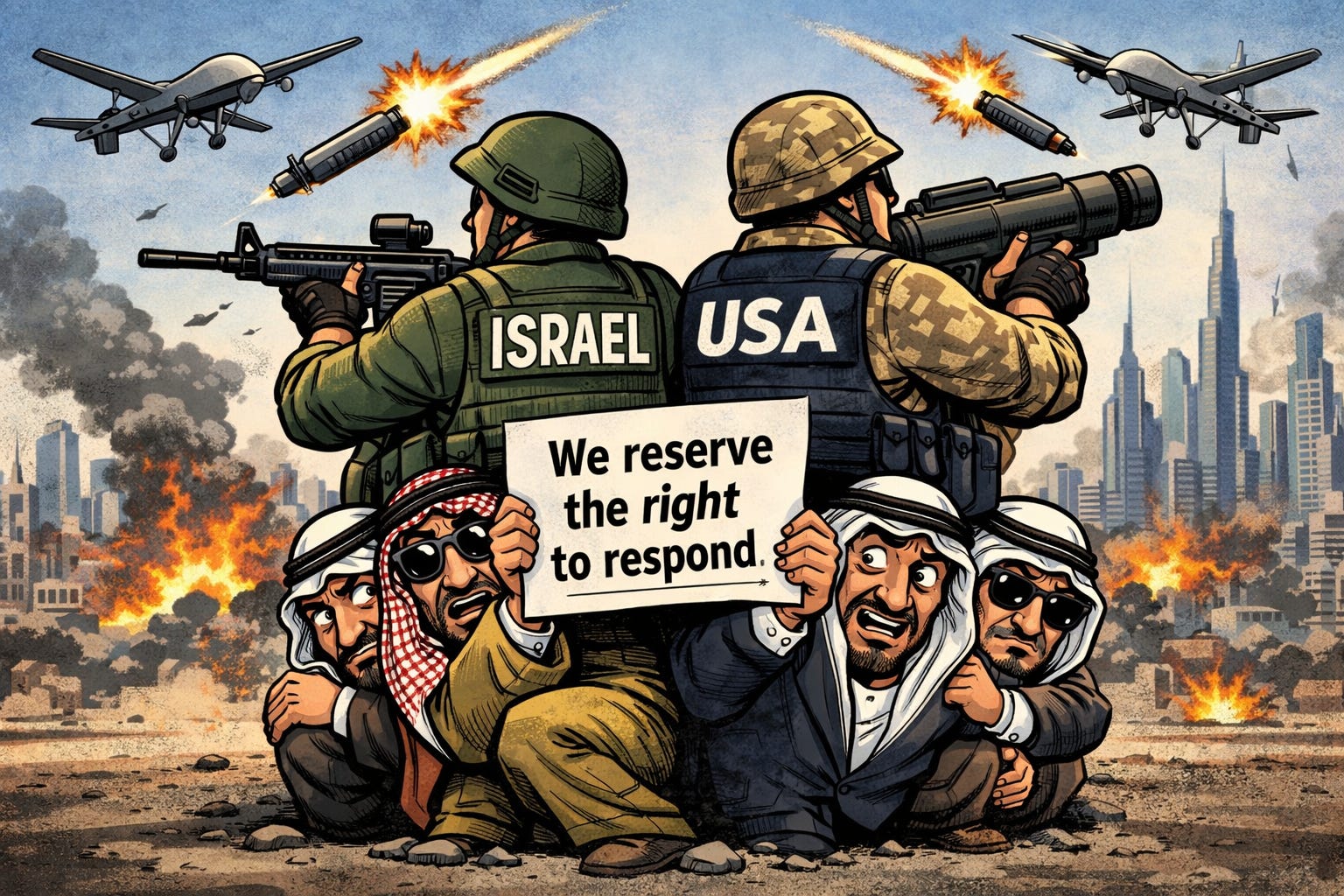
They issue graphic designs. They invoke international law. They say that they reserve the right to respond and that their patience is running thin.
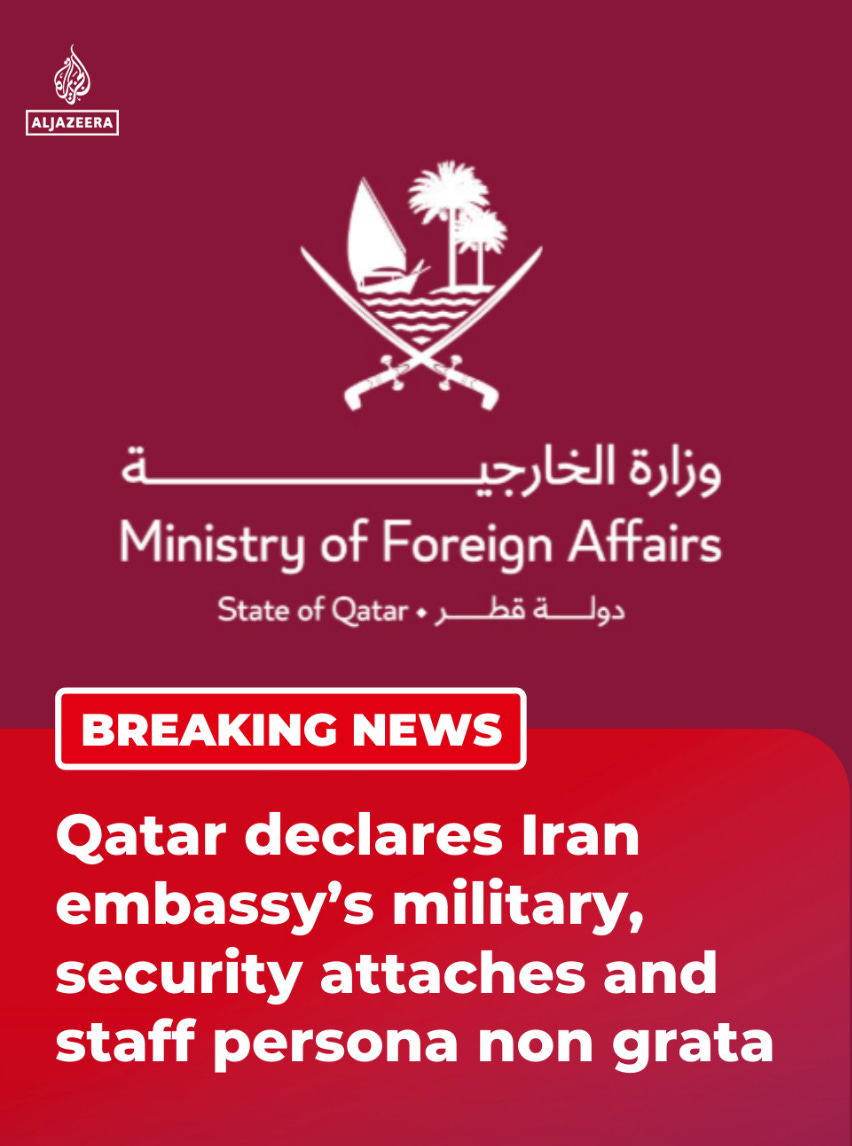
Even after Iran struck one of Qatar’s major natural gas facilities, their response was to give Iranian diplomats 24 hours to leave. That is absurd. It is the response of a clown state pretending to be a legitimate one.
These regimes cannot even hide behind the excuse of powerlessness. Qatar, the UAE, and Saudi Arabia have spent fortunes on the latest and greatest American and Western military equipment: jets, missile batteries, radar systems, command networks, elite training, and every visible symbol of modern force. They are not unarmed. They are not helpless. They are more than capable of joining the effort to strike the source of the threat and help Israel and America end it for good. But they do not. And that reveals something important. These are not fighting states. They are regimes of money, vanity, and hired protection. They use wealth to buy hardware, to rent security, and to bring in some mercenaries and foreign specialists, but not to cultivate courage and strategic independence. What, after all, do they need an army for, if not for this? If not for Iran, then for what? This is the moment for which a military exists. And they have failed it completely.
A state that is attacked has an obligation to stop the attacker. Not merely to absorb the blow. Not merely to intercept. Interception is not enough. Interception is mere survival. Defence means eliminating the source of the threat. Defence means ensuring that the next missile is not launched. That is what Israel and America are doing. They are carrying the burden while the Gulf states hide behind them, blame Israel and the US in public, and posture as though they are somehow above the war. Privately, many of them want Washington and Jerusalem to keep going until Iran can no longer threaten their lifelines. Publicly, they speak the language of appeasement, international law, and de-escalation. They want the result, but not the responsibility. They want the danger removed, but not by their hand.
Saudi Arabia, the largest and supposedly most powerful of these states, may be the most humiliating example of all. For over twenty days, it has been under direct attack. Its capital city has been targeted. Its oil infrastructure has been hit. And what does Riyadh have to say after all this? Yesterday, their foreign minister said this:
The patience that is being exhibited is not unlimited.
After twenty days of missiles and drones, that is what they have to say? It is grotesque. A regime with all that wealth, all that prestige, and all that American-supplied hardware still answers deadly attacks with words. Not action. Just patience, delay, and diplomatic language. And this is not even the first time. In 2019, Saudi Arabia’s oil heart was struck by Iranian proxies, and even then, the lesson Tehran learned was the same: that the kingdom’s most vital infrastructure could be hit without any truly devastating response. Saudi Arabia taught Iran that lesson once already. It is repeating it again now. 
And Kuwait should be stated bluntly. Without the U.S.-led coalition in 1990, Kuwait would have become Saddam Hussein’s territory. That is a historical fact.
One can go further. Had Iran been allowed to move unbroken toward a nuclear weapon, these states would likely now be facing not just these missiles and drones but nuclear bombs.
And here the contrast with Israel matters. Israel did not simply write cheques and hope for the best. It built capacity. It built doctrine. It built technology. It built a culture that takes existential threats seriously. The Gulf regimes, by contrast, have largely used money to buy systems, borrow deterrence, and rent security. That is not the same thing as building a moral state.
That is why the word ‘parasitical’ fits. These so-called kingdoms are, more precisely, oil-funded feudal orders. They do not generate strength so much as fasten themselves to it. They feed on American power. They leech off Israeli blood. They draw their sustenance from Western technology, Western force, and a regional order maintained by others. They want sovereignty without burden, safety without courage, and strategic gains without strategic action.
And their ugliness is not only external. It is internal too. These are not free societies. They are regimes of censorship, hierarchy, and intimidation, sustained in part by systems of near-servile imported labour and by populations denied the elementary rights of free citizens. There is no freedom to criticise the government, no elections. What they market as modernity is, underneath the glass and spectacle, a fundamentally unfree and morally degraded social structure.
That matters because a regime’s conduct in war does not float above its character at home. It grows from it. A society built on fear, deference, and controlled speech will not suddenly produce courage, independence, and moral worth when missiles begin to fall. It will produce what it already knows: passivity, PR management, and dependence on others. Authoritarianism is not power. It is weakness institutionalised. It is what insecure rulers build when they know that free men and women would not willingly grant them such power. That is why these regimes appear so spineless now. They are not betraying their nature. They are revealing it.
Dependent. Evasive. Parasitic. Illegitimate. That is what these regimes are. A state exists to defend the lives of its people. If it will not do that, if missiles can strike its cities and infrastructure again and again and nothing meaningful follows, then it has forfeited its claim to sovereignty in any moral sense. What remains is not a moral nation but a hollow shell: an assembly of wealth, spectacle, and foreign protection pretending to be a state.
Israel, by contrast, remains the one state in the region acting on the full moral principle of self-defence. That is why it stands alone as the region’s only real moral beacon. Not because it is perfect. It is not. It is deeply flawed in many ways, and I have said so often. But it is, fundamentally, a free society. Its citizens can speak, argue, criticise, vote, create, build, and fight as self-governing human beings. That is precisely why it can fight. Liberty is not a weakness. It is a strength.
This war should force a rethinking of the Abraham Accords themselves. I argued before against the fantasy of Saudi Arabia joining them, and these events have only clarified why. What exactly is the value of an accord with regimes that blame Israel for acting in self-defence while quietly benefiting from that very action? What kind of partnership is this, in which Israel is expected to carry the burden of courage while its supposed partners reserve for themselves the comfort of denunciation, appeasement, and moral distance?
There may be economic benefits in dealing with these states. That is true. But they are limited, transactional, and tied to regimes that have now revealed their true nature. Economics is not the highest issue here. Survival is. Human flourishing is. Civilisation is. And in that realm, these regimes have shown that they are incapable of standing as partners.
The deeper conclusion is this: these are not the accords that matter.
The real accord—the real Abrahamic accord—is not with these oil-funded, neo-feudal orders, built on modern slavery, dependence on the US, and the hollow prestige culture of TikTok influencers. It is with a future free Iran.
A free Iran would not be a client state, not a façade sustained by foreign protection, not a regime that hides behind others while condemning them in public. It would be a real nation: with scale, depth, history, human capital, and civilisational weight. With such a country, one would not need to pretend. One could have real trade, real cooperation, real peace.
Not “normalisation”, but genuine partnership. Not an arrangement of convenience, but a relationship of substance.
And in that light, the supposed importance of the Gulf regimes shrinks dramatically.
They are not the future of the Middle East but an interlude.
The future is with Israel and a free Iran. And it’s coming closer by the day.
If you enjoyed Philosophy: I Need It, and want to see more, you can support my work by buying me a coffee. Every contribution makes a real difference. Thank you!
On the point of the Gulf states blaming Israel & the US for their being attacked: one contrast that came to mind is the complete silence from these states on Russia's continued support of the Iranian regime, and its reported assistance to the regime in targeting assets in the Gulf states. They will blame Israel & the US for addressing the threat, and say nothing about Russia's enablement of that threat.
Great commentary.