

I. An Intellectually Rewarding Disappointment
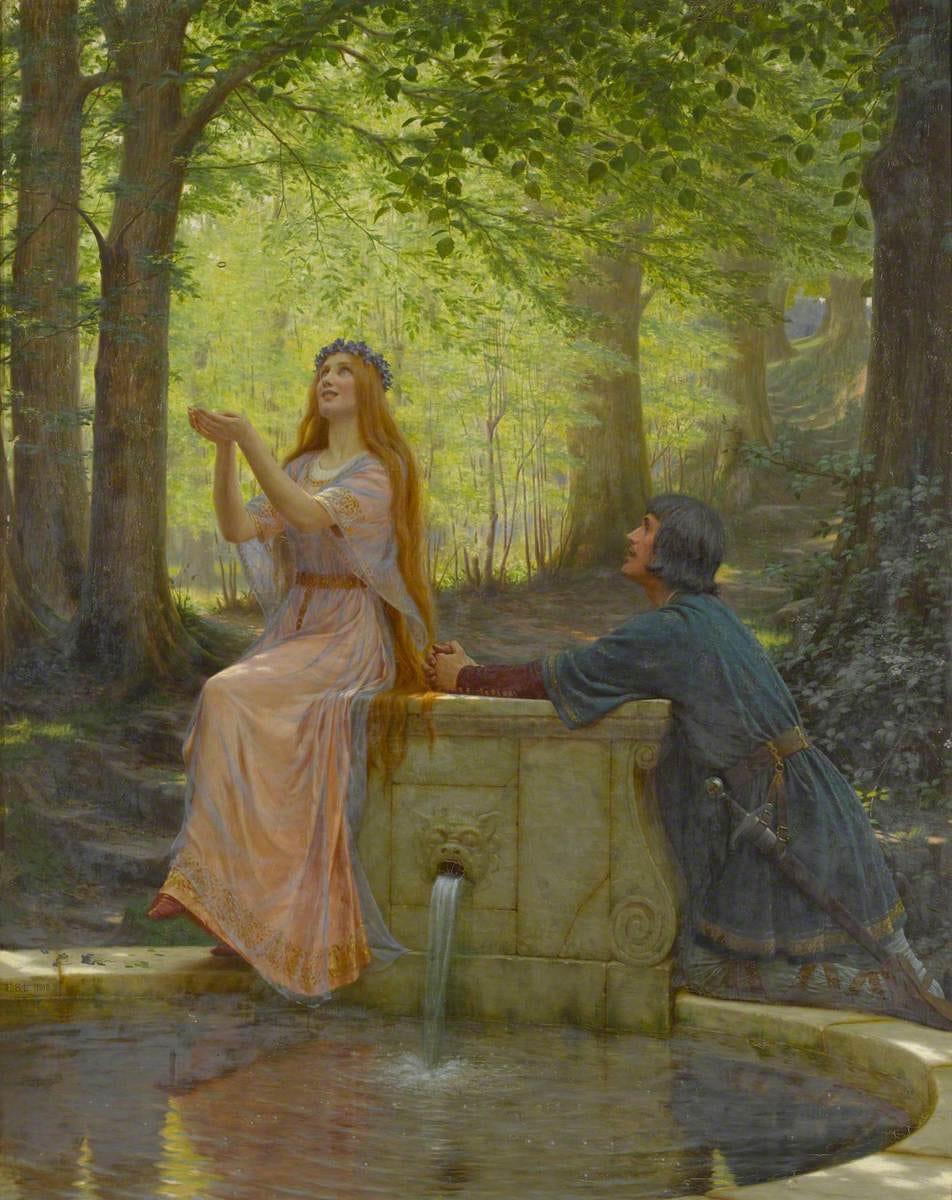
For several weeks, I have been thinking about an opera I found extraordinarily boring. This is rather unusual. When an opera bores me (which happens often), I rarely think about it again, let alone write an essay about it.
But Claude Debussy’s Pelléas et Mélisande did more than bore me: it profoundly irritated me. The more I reflected on that irritation, the more interesting the work became.
I attended a performance at Prague’s National Theatre knowing virtually nothing about the opera. Opera is a new fascination of mine, and I was curious to hear how Debussy’s musical language would translate to the stage. The orchestral colours and vivid instrumentation his music is known for initially impressed me, but the music is predominantly quiet, with few dramatic climaxes, and over three and a half hours including intervals I found it ultimately a dull experience.
Much of what distinguishes Pelléas et Mélisande can be understood in light of Debussy’s ambition to depart from the Wagnerian conception of opera. In choosing a play from Maurice Maeterlinck’s early Symbolist period, Debussy found a dramatic counterpart to his musical ambitions. The grandeur, dramatic climaxes and philosophical explicitness so characteristic of Wagner give way to understatement, ambiguity and suggestion.
As the drama repeatedly subverted my expectations of storytelling, boredom gradually gave way to something quite different: philosophical outrage.
One of the things I am discovering about opera is how philosophically rich an art form it can be. I would rather engage with a work whose philosophy I vehemently oppose than one that offers little of intellectual substance (of which there’s certainly no shortage). Behind what initially seemed like three and a half hours of dramatic inertia lay a consistent conception of human existence—one I find philosophically perverse but worthy of serious examination.
I hope to communicate something of the intellectual pleasure to be derived from engaging with opera, even when the experience of attending isn’t as pleasurable.
II. A World That Cannot Be Known
Most of us are familiar with the dramatic principle known as Chekhov’s gun: if a gun appears in the first act, it ought to be fired by the third. The author introduces elements into a story with a purpose, the significance of which becomes apparent as the drama unfolds.
Pelléas et Mélisande systematically subverts this expectation.
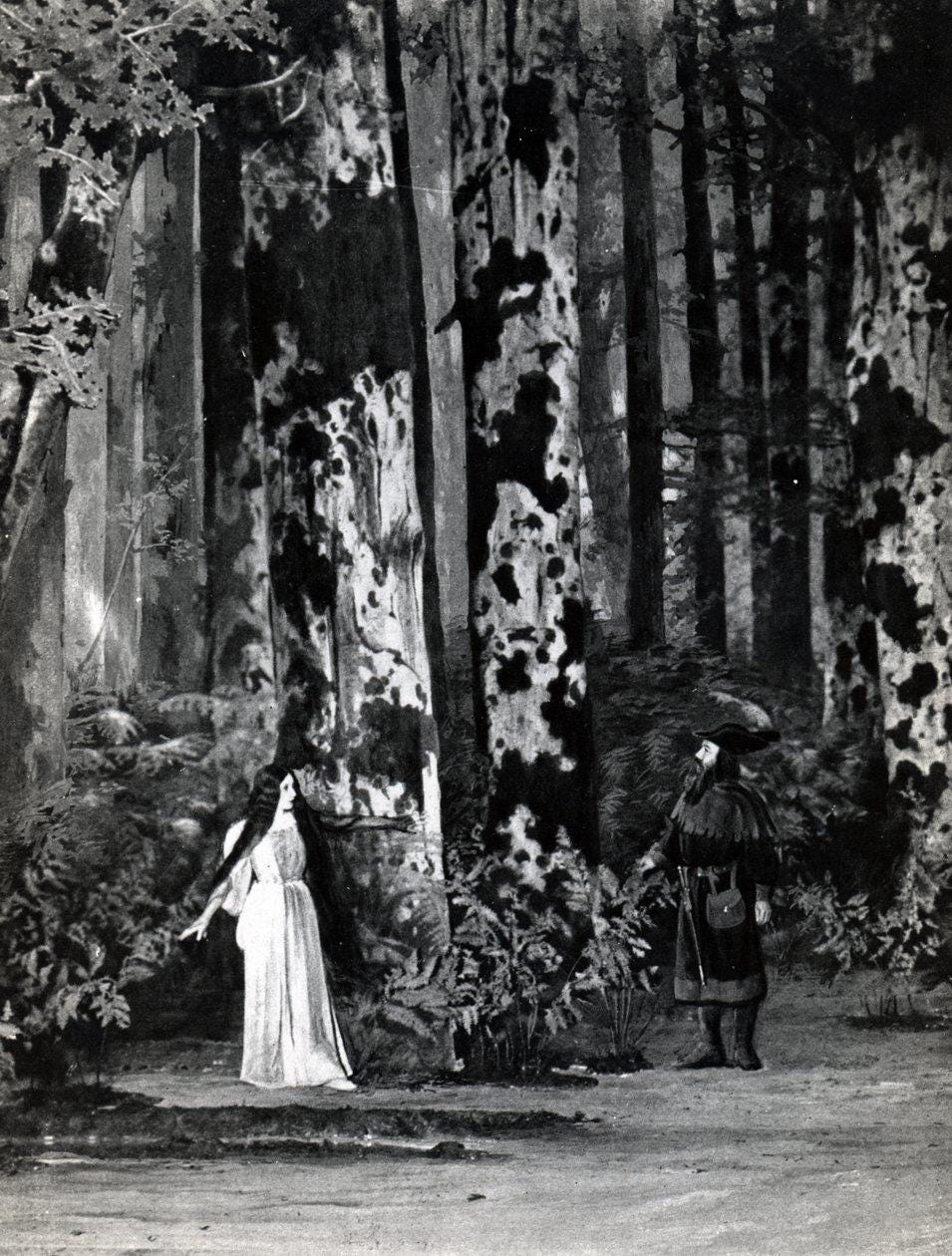
The opera opens in a dark forest, where Golaud, the grandson of King Arkel, has lost his way while hunting. He encounters a mysterious young woman weeping beside a fountain. At the bottom of the water lies a crown given to her by an unidentified man. She refuses to let Golaud retrieve it, declaring that she would rather die. We do not know where she comes from, what has happened to her or why she is so frightened. All we learn is her name: Mélisande.
It is an intriguing opening, and Debussy’s music deepens its mystery. Who is this woman? What is the significance of the crown? What has she escaped from?
A letter to Pelléas, Golaud’s half-brother, reveals that Golaud has married her. He admits that he knows neither her age nor her origins: “It is now six months that I married her and I know no more than the day of our meeting.”
One wonders what they talk about over dinner.
It is entirely conceivable that a traumatised woman might refuse to discuss her past. But surely six months of married life ought to reveal something of a person’s character, irrespective of how much she discloses about her history.
Fortunately for the audience, Maeterlinck still resorts to such conventional dramatic devices as jealousy, suspected adultery and murder. Without these concessions to intelligibility, one wonders what Debussy would have had left to put on the stage.
Yet even the central dramatic conflict offers no satisfactory resolution. In the third act, Golaud lifts his young son, Yniold, to Mélisande’s window, hoping to discover what takes place between her and Pelléas in private. The child sees them standing silently, looking at the light. Nothing of consequence is revealed. Pelléas and Mélisande eventually declare their love, but the precise nature of their relationship remains obscure. At Mélisande’s deathbed, Golaud desperately tries to establish whether she was unfaithful. He never attains the certainty he seeks. Neither does the audience.
By the end, I was asking myself: what on earth had I just watched? After all this time, I understood virtually nothing more about Mélisande than I had when she first appeared in the forest.
It might be objected that Pelléas et Mélisande is a fairy tale and that I am imposing upon it expectations of psychological realism that are inappropriate to the genre. But a fairy tale is a means of communicating something, not an exemption from the requirement to communicate something. I am perfectly willing to suspend my disbelief about the events depicted. What I want to understand is their significance.
The opera continually introduces elements that appear charged with meaning: the submerged crown, the wedding ring lost in another fountain, the departing ship that may be wrecked at sea, three sleeping beggars in a grotto, a fountain once believed to restore sight and the nearly blind king. The imagery of darkness and light permeates the drama.
What, then, does all this symbolism communicate? Initially, the accumulation of these elements creates an impression of considerable depth. But insofar as these symbols can be interpreted, they overwhelmingly suggest the same few things: blindness, helplessness and impending doom. The abundance of symbols conceals a remarkable poverty of meaning.
What is particularly interesting, however, is that Maeterlinck makes the audience experience the very condition in which his characters exist. Like Golaud, we are continually confronted with things we wish to understand, only to be repeatedly frustrated in our attempts to do so.
The obscurity of the drama is not incidental to its philosophical meaning; it is the means by which that meaning is communicated. Maeterlinck makes our inability to understand the drama a dramatisation of man’s inability to understand his own existence.
There is a logical contradiction in employing symbolism to communicate the impossibility of knowledge. The very practice of symbolism presupposes man’s capacity to establish an intelligible relationship between an object and an idea. Yet Maeterlinck invites us to exercise precisely this capacity in order to discover its futility.
Consider, by contrast, Mozart’s fairy tale, The Magic Flute, which premiered in 1791. Here, too, light and darkness are central to the symbolism of the work. But the struggle between them is a struggle between knowledge and ignorance. Knowledge is an achievement, wisdom a virtue, and the opera culminates in a glorious celebration of the triumph of light over darkness.
In the world of Pelléas et Mélisande, a century later, darkness is no longer something to be overcome. It is the inescapable condition of human existence. Where Mozart presents mystery as something to be resolved, Maeterlinck presents it as a permanent fact of reality.
Is this contrast not symbolic of the broader philosophical trajectory from the Enlightenment to modernism?
But the implications extend well beyond the question of what man can know. If man cannot understand the world in which he lives, what possibility is there for him to direct his life within it?
III. A World Without Choice
In Maeterlinck’s world, human actions repeatedly lead nowhere, while events of considerable consequence have no intelligible cause.
When Mélisande loses her wedding ring in the fountain, Golaud is thrown from his horse at precisely the same moment. There is no intelligible causal connection between the events, yet the coincidence carries an almost supernatural significance. Pelléas repeatedly announces his intention to leave the castle but never manages to do so. Little Yniold attempts unsuccessfully to move a rock trapping his golden ball. The imagery of human impotence is painfully explicit.
Mélisande herself embodies this conception of human existence.
The problem is not that we never discover her past. We can come to know a person through her values, aspirations, choices and actions, irrespective of how much we know about her history. What, then, does Mélisande do to shape her life?
She marries Golaud for reasons that remain obscure and subsequently falls in love with his brother. What does she recognise in Pelléas that she does not find in Golaud? What does she want from life? She expresses a desire to leave the castle, yet makes no serious attempt to escape.
Her life consists overwhelmingly of things that happen to her rather than things she makes happen. Even her death follows this pattern. Golaud wounds her, but the physician offers this remarkable medical assessment: “It is not from this little wound that she can die; a bird would not die from it…” She then proceeds to die.
Interestingly, in Maeterlinck’s original play, the physician offers an additional explanation, which Debussy omitted from the opera: “She was born without reason… to die; and she dies without reason.”
As an expression of Maeterlinck’s philosophical outlook, this is actually rather effective. Even Mélisande’s death is presented not as an intelligible consequence of human action but as something inexplicably imposed upon her by existence itself.
It is difficult to imagine a more explicit expression of the conception of existence underlying the work.
What makes all this interesting to me is how methodically it is done. I have encountered operas whose dramatic deficiencies I would attribute merely to poor writing. But the apparent lack of dramatic purpose in Pelléas et Mélisande is itself remarkably purposeful.
Maeterlinck was quite explicit about his dramatic ambitions during this period. In The Tragical in Daily Life (1894), he argues that a motionless old man submitting to his fate is a more profound dramatic subject than a man performing great deeds. He is interested not in man’s purposeful action on the world, but in his exposure to existence’s mysterious forces.
Although Maeterlinck would later depart from this conception of drama, it is central to understanding Pelléas et Mélisande. Its characters resemble billiard balls: they collide with one another, producing consequences largely beyond their comprehension and control.
What, then, becomes of morality and justice in such a world?
The appropriate attitude towards existence, it seems, is resignation. Upon learning of Golaud’s unexpected marriage in the first act, Arkel declares: “I have never put myself at cross purposes with a destiny.” The statement could serve as the governing principle of the entire drama.
Later, Golaud seizes Mélisande by the hair and drags her around the room in the presence of Arkel. The king protests but does little to interfere. His response culminates in an expression of pity for the hearts of men. A man brutalises a defenceless woman before the very person empowered to act, and the principal moral response is one of helpless resignation.
Golaud subsequently murders his brother. Driven by jealousy, he kills before establishing the very thing he wishes to know. His remorse brings no reckoning beyond his own suffering. In the closing moments of the opera, Arkel even assures him that Mélisande’s death is not his fault.
What a remarkable consolation to offer a man who has murdered his brother and brutalised his wife.
My objection is not that evil triumphs or that innocent people suffer. Neither is inherently objectionable as the subject of a tragedy. I object to the systematic dissolution of the distinction between suffering brought about by man’s choices and suffering imposed upon him by circumstances beyond his control. Everything is enveloped in the same atmosphere of pity, helplessness and resignation. Even the perpetrator of evil comes to resemble another victim of existence.
Arthur Schopenhauer’s conception of tragedy comes to mind in this context. In The World as Will and Representation, he argues that it is not the hero’s individual transgressions for which he atones, but “original sin, i.e., the crime of existence itself.”
There is an enormous difference between portraying suffering as an aspect of human existence and portraying suffering as its essence; between depicting a man who has been defeated and depicting man as a being destined for defeat.
Nowhere is this distinction more apparent than in the opera’s closing moments.
The attention turns to Mélisande’s newborn daughter. Mélisande herself has already expressed pity for the child, anticipating that she, too, will weep. Arkel’s final words announce: “It is the turn of the poor little one.”
Her turn to do what? To live? To suffer?
The child enters the world having made no choices and formed no aspirations, yet the fundamental character of her existence appears to have been determined in advance.
Man is born, he suffers and he dies. And then it is somebody else’s turn.
IV. Between Tragedy and Despair
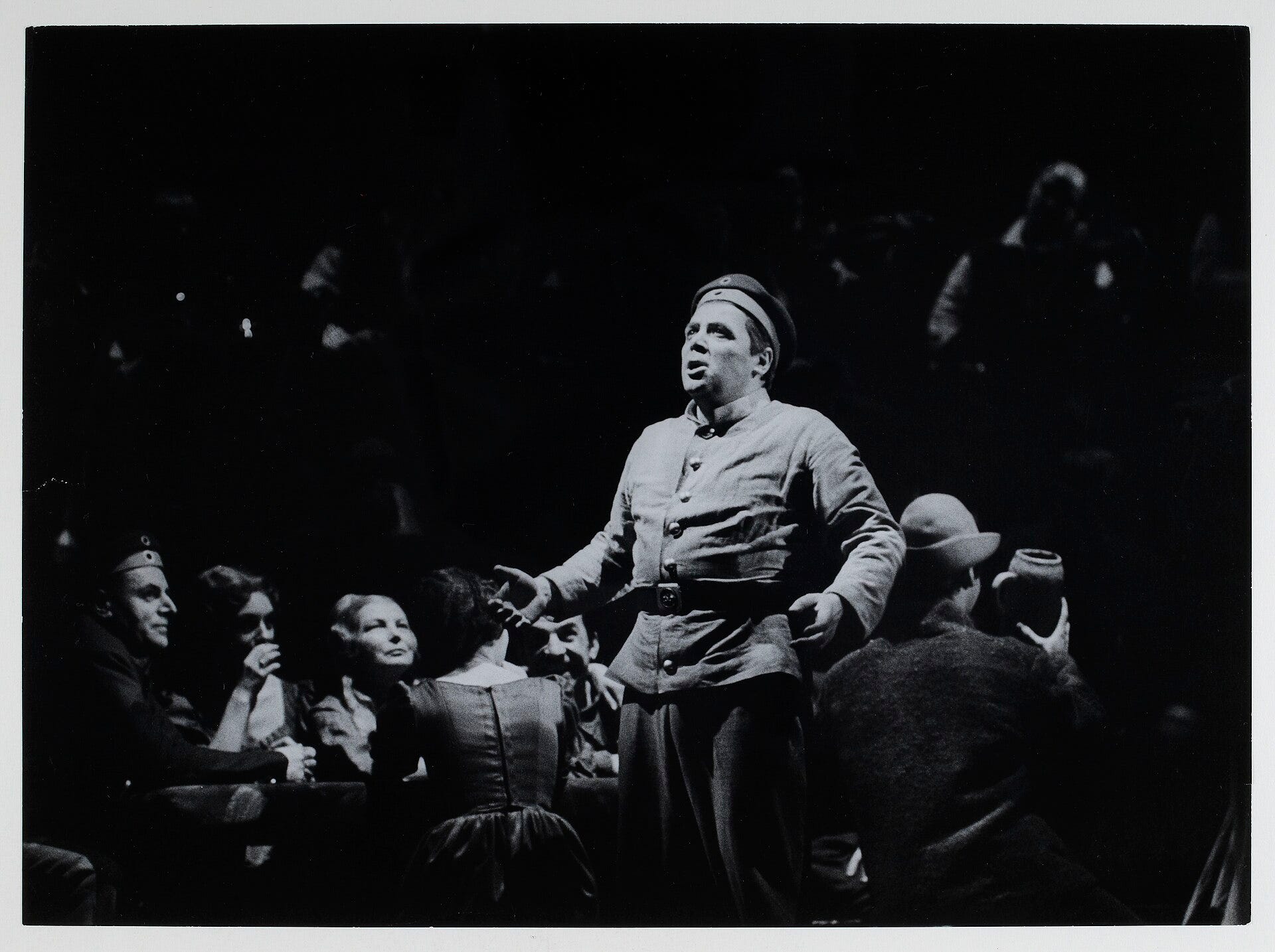
Twenty-three years after the premiere of Pelléas et Mélisande, another opera made its debut which also concludes with a child inheriting the tragic circumstances of its parents. In the closing scene of Alban Berg’s Wozzeck, a little boy rides his hobby horse, scarcely comprehending the news that his mother is dead.
The similarities between the two works are all the more striking given that Berg himself studied Debussy’s opera as a model for the dramatic structure of Wozzeck. His surviving sketches even contain a side-by-side comparison of the two works. Yet within a similar framework of short scenes linked by orchestral interludes, Berg restored precisely what Maeterlinck had removed: the causal connection between events.
Both operas are landmarks of musical modernism. Both depict profoundly pessimistic worlds. There is, however, one considerable difference between them: I find one extraordinarily boring and the other extraordinarily exciting.
There is something profoundly human about Wozzeck. We understand its protagonist’s humiliation, poverty and jealousy, the cruelty of the Captain, the Doctor’s experiments and Marie’s infidelity. We witness his gradual psychological disintegration. Berg’s music allows us to experience something of his increasingly disturbed perception of reality. His confusion is intelligible to us, even when reality is becoming progressively unintelligible to him.
Some readers might find it surprising that I consider Wozzeck the less pessimistic of the two operas. Berg’s musical language is considerably more radical than Debussy’s, yet the philosophical pessimism of Pelléas et Mélisande runs deeper.
Berg presents the tragedy of a man who is losing his ability to make sense of the world; Maeterlinck presents a world that appears fundamentally unintelligible. In the former, we understand the tragedy; in the latter, our inability to understand is the tragedy.
The distinction extends to the moral character of the two works. In Wozzeck, the cruelty of the Captain and the Doctor is recognisable as cruelty. We understand the injustice to which Wozzeck is subjected, just as we understand the horror of his murder of Marie. Our sympathy for his suffering does not require us to absolve him of responsibility for his actions.
In Pelléas et Mélisande, by contrast, the distinction between the perpetrator and the victim of suffering is dissolved into a more universal conception of human misery. Where Berg portrays the tragedy of a particular human life, Maeterlinck seems to lament the very condition of being human.
Aristotle’s Poetics helps explain why intelligibility matters to tragedy. In discussing its capacity to arouse pity and fear, Aristotle observes that its emotional effect is heightened when events “follow as cause and effect.” Our understanding of the causes of Wozzeck’s suffering intensifies our emotional experience of it.
Maeterlinck’s conception of static theatre represents an almost complete reversal of this aesthetic principle. Where Aristotle places human action at the centre of tragedy, Maeterlinck places human helplessness. The result, to my mind, is something closer to an expression of existential despair than a compelling human tragedy.
It might be argued that the emotional meaning of Pelléas et Mélisande is conveyed primarily through Debussy’s music. But what emotional experience does the music convey? To my ears, it is predominantly one of mystery, foreboding and resignation. Far from contradicting my interpretation of Maeterlinck’s world, Debussy’s music reinforces it.
In Wozzeck, by contrast, Berg’s music enriches our understanding of the protagonist’s psychological disintegration, while the drama itself establishes the circumstances that bring it about. We don’t need to analyse the score to understand his tragedy, but doing so can considerably deepen our appreciation of it.
We must not forget that these works are dramas. Philosophical interest is no substitute for dramatic power. However bleak Wozzeck may be, the intelligibility of its characters and their suffering makes it a compelling theatrical experience.
As for Pelléas et Mélisande, the very existence of this essay is a testament to its intellectual interest. However little I enjoyed watching it, I cannot dismiss a work that has stimulated so much thought as a meaningless waste of time.
But intellectual interest is not the only value I seek from opera, nor would I ordinarily wish to spend my evenings contemplating the horrors of human existence. Both works are emotionally draining, and neither is an opera I would recommend to someone just beginning to explore the art form. For experienced opera-goers seeking a musical challenge, however, I do recommend seeing Wozzeck in the theatre.

For those who have yet to discover the pleasures of opera, there are far more rewarding places to begin. Go and experience the passion and dramatic power of Puccini’s Tosca. Better yet, after all this talk of the inevitability of darkness, do yourself a favour and go and see Mozart’s The Magic Flute.
If you enjoyed Philosophy: I Need It and want to see more, you can support my work by buying me a coffee or becoming a monthly supporter.
Every contribution makes a real difference. Thank you!

And if you’re looking for something longer, my debut novella, The Weight of Silence, is available on Amazon. Get your copy here.