

I. The Encounter
In 1965, Gilbert Kaplan was twenty-five years old and working on Wall Street. His life belonged to the world of finance, deadlines, ambition, and New York momentum. Nothing in it seemed to point toward Gustav Mahler.
A close friend asked whether he wanted to come to a rehearsal of Mahler in Carnegie Hall. That was all he said: Mahler. Kaplan was not especially interested, but he agreed. He had no idea what he was about to hear. The orchestra was the American Symphony Orchestra. The conductor was Leopold Stokowski.
At first, nothing outwardly dramatic occurred. Kaplan stayed for the entire rehearsal and found the music interesting, perhaps even strangely compelling, but he left without imagining that anything decisive had happened. He had heard something unusual; that was all.
And yet that night he could not sleep.
The music returned to him in fragments. Sounds kept coming back to him, unbidden, insistent, as if something had entered his inner life without permission and refused to leave. He was restless, haunted. Whatever he had heard that afternoon had lodged itself somewhere deeper than ordinary enjoyment. It had not merely impressed him. It had taken hold of him.
The next day, he bought a ticket to the performance.
This time, he sat through the full concert, and the symphony began to work on him with increasing force. What had seemed merely unusual at the rehearsal now revealed its full scale. The music moved through grief, terror, struggle, and longing toward something vast and exalting, and by the final moments, Kaplan was sobbing, nearly hysterical. A boundary had been crossed. His life would never be the same again.
That was how the call arrived.
Not as a grand decision. Not as the culmination of years of preparation. It came almost by accident, through a friend’s invitation, through a rehearsal he had little reason to attend, through a sleepless night, and then through a performance that completed what the rehearsal had begun. A young man went to hear Mahler without knowing what he was in for, and from that moment onward the music refused to leave him.
What happened next would have seemed improbable to anyone who had watched him walk into that rehearsal. But that came later. For now, it was enough that something had begun. The experience did not recede into memory. It remained, deepened, and refused to leave him.
II. The Resurrection
What kind of music was this that a young man could wander almost accidentally into a rehearsal and then lie awake at night, unable to escape its return?
Not the kind that merely pleases. Not the kind that decorates life, refines taste, or offers culture as a polite accomplishment. Mahler’s Second asks for something far more dangerous than admiration. It asks whether one is still capable of wanting the highest things.
This is why the symphony cannot coexist with the cynic. Not because it argues against him in concepts, but because it renders him trivial. It has no patience for the man who sneers before he feels, who calls longing childish, who treats reverence as embarrassment, and who hides behind irony because he has already decided that greatness is unattainable. Mahler does not flatter that part of the soul. He destroys it.
And he does so honestly. Nothing here is cheap. Nothing is granted in advance. The symphony begins in catastrophe: the funeral march of the first movement is immense, apocalyptic, and unsparing. Death is not hinted at. It is declared. Something great has fallen, and the music knows it. It cries out over the death of the hero with a force that makes lesser notions of tragedy sound decorative.
Then comes memory. The second movement turns backwards toward life, toward dance, tenderness, innocence, and distance. It does not yet redeem what has been lost. It remembers it. It looks back upon life with nostalgia, with beauty, with the aching grace of something already gone.
But memory is not enough. The third movement begins to twist. Here irony enters fully. Motion continues, but meaning begins to dissolve within it. The world starts to sneer. The spirit reels. One feels, from within the music itself, the temptation of mockery, instability, and exhaustion. It is here that the symphony passes through the territory of the cynic, not as a posture, but as a genuine spiritual danger.
And then, when it almost becomes unbearable, comes Urlicht (Primal Light).
Not triumph. Not spectacle. A voice.
After all the scale and violence that precede it, this entrance feels almost impossible in its simplicity: “O Röschen rot!” (“O little red rose!”) A small human plea rising out of the abyss. “Der Mensch liegt in größter Not! / Der Mensch liegt in größter Pein!” (“Man lies in greatest need! / Man lies in greatest pain!”) Nothing could be further from the smugness of the cynic. This is not cleverness. It is a necessity. It is the naked wish that suffering would not be final. It does not yet answer the symphony’s question. It does something harder. It reopens the possibility that an answer may exist.
And then the heavens break open.
The finale does not merely conclude. It erupts. The skies are torn apart. The dead are summoned. What began with funeral rites now strains toward resurrection, not as ornament, not as pious decoration, but as a victory wrestled out of terror, grief, irony, collapse, and endurance. And when at last the chorus enters, “Aufersteh’n, ja aufersteh’n wirst du” (“Rise again, yes, you shall rise again”), the entire symphony has earned the right to say it. This is not optimism. It is a transfiguration purchased at the highest cost.
That is why Mahler’s Second overwhelms in the way it does. It does not offer cheap consolation. It does not flatter weakness. It does not tell man that suffering is unreal, only that it is not final. It passes through death, irony, terror, and collapse, and still dares to say yes. That is the power of it.
And once such a work enters a life, it does not simply sit there as a beautiful experience. It begins to work on a man. It returns in fragments, in memory, in longing, in unfinished pressure. What Kaplan had encountered was no longer merely a symphony he admired. It had become a force in his life.
III. The “Amateur”
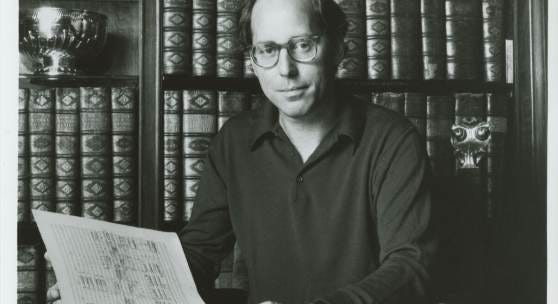
What made Kaplan unusual was not merely that he loved the symphony. It was that the love did not remain at the level of admiration. It grew, year after year, into something more demanding.
For a long time, the obsession remained inward. He built his career, worked full-time, and created an immensely successful financial publication. But all the while Mahler’s Second remained a permanent force in his life. He pursued it with extraordinary seriousness. He listened to every recording he could find, read every book and essay available to him, sought out every living expert he could reach, and travelled widely to hear the work performed wherever he could. This was the 1970s. There was no internet, no instant archive, no effortless abundance of information. Everything had to be hunted down deliberately, and he hunted it down.
At a certain point, he had consumed nearly everything that could be consumed from the outside. He had heard the symphony, studied the symphony, and followed the symphony across the world. And then he realised that there remained one level of encounter he had not yet unlocked, perhaps the highest one: not merely to hear the work, not merely to study it, but to stand inside it and bring it to life himself.
That was the moment.
It was not the decision of a young enthusiast in the first heat of inspiration. It came only after years of obsession, years of listening, years of study, years in which the music had remained present and deepened rather than faded. And it came, too, at a point in his life when he had the means to take such a decision seriously. He could afford the time, the instruction, and the discipline that such an insane ambition would require.
‘Insane’ is not too strong a word for how it must have sounded. Kaplan had no musical training whatsoever. No conservatory background. No institutional pedigree. No ordinary path could justify such a leap in advance. Most people, hearing such an idea, would have laughed at it, and many did. But he did not treat it as fantasy. He treated it as a responsibility.
He found a private tutor, a young professional conductor, and devoted himself to study with punishing seriousness. In the summers, he worked for eight hours a day; during the rest of the year, for three. At first, he conducted from memory, not out of theatrical bravado, but out of limitation: he could not yet read a full orchestral score well enough to conduct from the page. But what began as a necessity became a mastery. Over time, he came to know the work from within, until every passage, every entrance, every bar lived in his memory. The symphony was no longer simply something he revered. It had become something he inhabited.
He even conducted it with a baton that had belonged to Mahler himself, as though every possible distance between the work, its creator, and the man who had devoted his life to it had to be narrowed.
That is the distinction on which the whole story turns. Kaplan did not choose conducting as an act of display. He arrived at it only after exhausting every other way of loving the work. Conducting was not the vanity of a rich amateur who wished to place himself above the music. Kaplan enriched his own life first. That was the motive, the meaning, and the achievement. That others were enlarged by it was the earned consequence of something genuinely his own.
He had listened from below, studied from below, pursued every trace of it from below, and at last concluded that the only way left to go deeper was to enter the work completely.
Only then did he step onto the podium.
IV. The Verdict
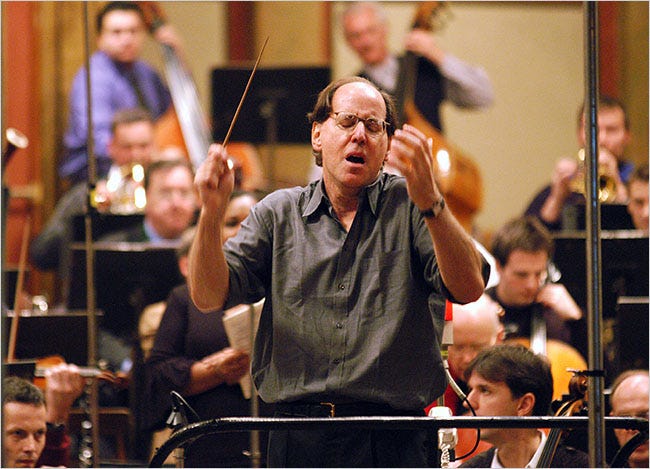
And when he did, he put far more than musical ambition on the line. He put his name, his seriousness, and the reputation he had built in another world at risk before the public.
At Lincoln Center, in his very first public appearance as a conductor, Kaplan invited thousands of colleagues from the financial world to hear him lead Mahler’s Second. It could have been a ruinous embarrassment. Instead, it became a triumph. The Village Voice critic would call it “one of the most profoundly realised Mahler Seconds in the last 25 years.”
Nor was it a one-night curiosity. He returned to the work again and again, conducting it over decades, in more than a hundred performances. The validation reached further still. The Vienna Philharmonic, the orchestra bound to Mahler by history itself, stood behind him. There would be a Deutsche Grammophon recording. What had once seemed absurd was now reality.
And that is where the story becomes philosophical. Because everything in our culture prepares us to misread such a life. If a man without credentials devotes himself to a work of art with total seriousness, we are taught to suspect vanity. If he crosses a boundary he was not meant to cross, we call it hubris. If he succeeds, we explain it away.
But there is simply no honest way to explain Gilbert Kaplan in those terms. The obsession is too specific, too exacting, too faithful for that. Had he wanted applause, he could have chosen something easier, broader, and more obvious. Instead, from 1965 until his death, he gave a vast portion of his adult life to a single work of art. One work. One symphony. One summons.
Everything was against him. No formal training. No natural path. No guarantee of success. He risked ridicule, embarrassment, and failure, and he went on anyway. Not because it was useful, but because he loved the thing and could not betray what he had heard.
That is not hubris. That is fidelity.
And more than that, it is self-interest in the highest and healthiest sense. Kaplan did not sacrifice himself to some dead duty, nor did he chase a hollow whim. He identified the thing that most deeply answered his soul and then built part of his life around it with discipline, courage, and joy. He lived his dream not as fantasy, not as escapism, but as achievement. That is one of the noblest forms self-interest can take: to recognise what one truly loves, what one cannot forget, what gives one’s life height and meaning, and then to pursue it seriously enough that it becomes real.
And because it was so genuinely his, it did not remain enclosed within him. That is the beauty of it. The healthiest self-interest is never sterile. When a man pursues the highest thing in himself honestly, the result need not diminish the world. It can enlarge it. Kaplan enriched his own life first, and precisely by doing so, he enriched the lives of others as well.
Even his conflicts reveal the same truth. And of course, there were conflicts. There had to be. But when they came, Kaplan did not hide behind the fashionable vanity of “my interpretation”. He returned to the score. That was his ground. Not whim, not ego, not self-display, but Mahler’s own markings, Mahler’s own instructions, and Mahler’s own command. As he himself put it, “I feel that I’m always working for Mahler.” And again: “Apart from tempo, I don’t ask the orchestras I conduct to follow my interpretation. I ask them to observe what Mahler wrote, and on most everything, I don’t lose an argument because it’s in the score.”
That is a profound clue to the kind of conductor he was. He did not stand before the work as a man trying to decorate it with himself. He stood before it almost as a disciple, trying with all the force available to him to serve the will of Gustav Mahler as faithfully as he could read it.
That is why Kaplan is heroic. Not merely because he pursued a passion, but because he carried it so far that it became history. He showed that one may begin late, begin outside the institutions, begin without permission, and still answer the deepest thing in one’s life with enough seriousness that it enters the permanent record. In that sense, he did more than fulfil a private dream. He widened the horizon of the possible.
And after each performance, there would be someone in the audience going through what had happened to him in 1965. Kaplan could see it in the face before him: the stunned look, the inner rupture, the sense that a boundary had just been crossed. That, perhaps, was the deepest reason he went on. Not applause, not recognition, but the sight of the symphony doing to another soul what it had once done to his. He once spoke of “living out their private dream.”
He was not only proving something. He was bearing witness. He was saying, in effect: this is the thing that took hold of my life, and I want you to hear why.
V. Maestro
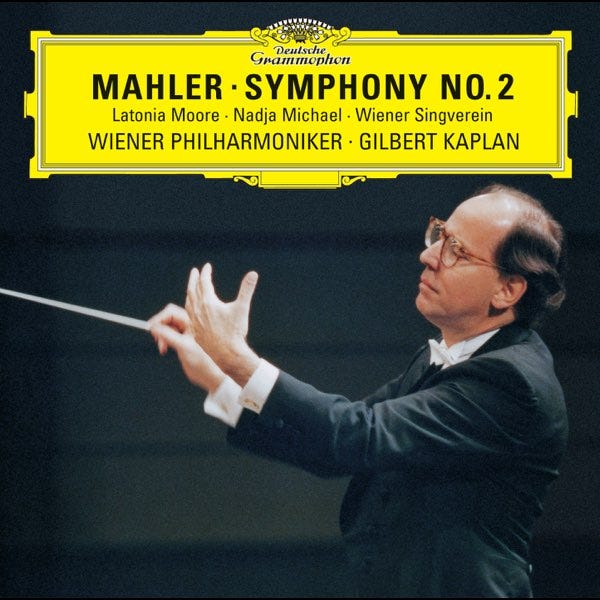
And so Gilbert Kaplan enters that rare lineage of cultural figures who do not merely admire greatness but cross into its history through the seriousness of their devotion. Not because he composed a symphony, and not because he was born into the world of conductors, but because he took one work of art so seriously that he made himself part of its living tradition. The financier, the outsider, the so-called amateur, reached a realm that should by every conventional measure have remained closed to him. That is why I do not hesitate, at the end, to use the title: Maestro Gilbert Kaplan.
But the point of the story is not to leave him frozen there as a monument. The point is the music itself. It always comes back to the music. What seized him in 1965 was not an idea, not a status, not a career path, but a real experience, one powerful enough to alter the course of his life. And what he wanted, clearly, was not only to go deeper and deeper into that experience himself but to place others before it as well. That is why he kept conducting the work. That is why he carried it across the world. That is why, after every performance, it mattered to him that somewhere in the audience another human being might be going through what he himself had once gone through.
So the proper end to this story is not reflection, but action.
Listen to the Resurrection Symphony.
Not as homework. Not as a cultural duty. Not because one is supposed to admire Mahler. Listen to it because something immense is there, and because there remains the possibility that it may do to you, in some measure, what it once did to Gilbert Kaplan.
If you have read this far and have not yet heard it, then go and hear it. Better still, begin with Kaplan’s recording of the Resurrection Symphony with the Vienna Philharmonic on Deutsche Grammophon, and let him try, one more time, to pass the experience on.
If you enjoyed Philosophy: I Need It, and want to see more, you can support my work by buying me a coffee. Every contribution makes a real difference. Thank you!
Now that is a resurrection worth celebrating.