

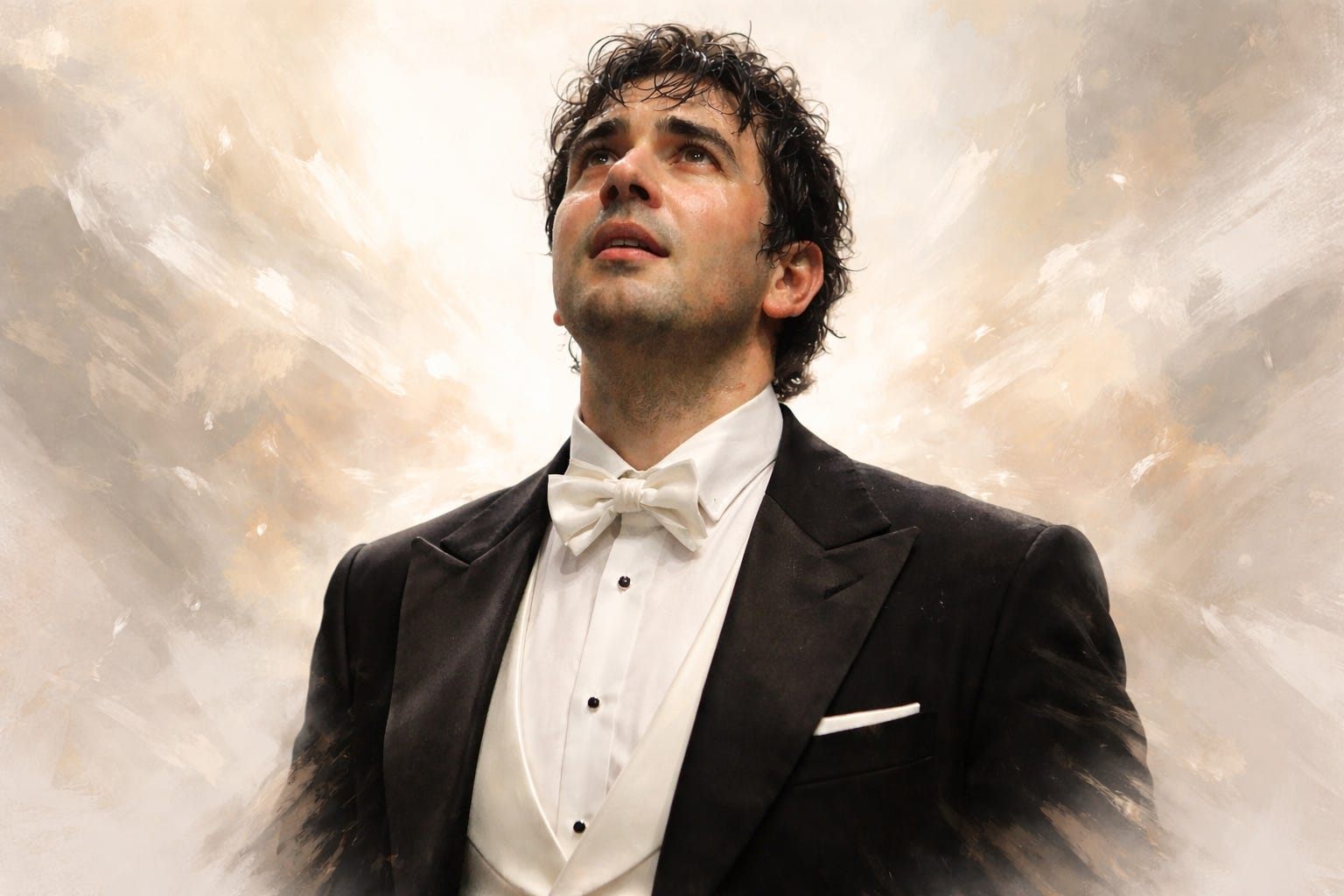
I. Allegro
“I am going to write a symphony.”
He kept on saying to himself,
to his teachers,
to his family.
to his friends.
Nobody writes symphonies anymore.
That was the usual reply.
“What do they perform in the hall?”
He used to ask in return.
Silence was always the answer.
“What are you? Brahms?”
“I am Raphael.”
He would always say back.
He always had the idea:
It’s going to start lyrical,
Like a great violin concerto.
The second movement will be stormy,
The third, playful, yet gloomy.
And the finale,
Epic.
He would not go anywhere without his scores.
He treated his sheet book like a bible.
Even more than that.
He had in his room a portrait of Beethoven.
He would stare at him.
sometimes for long hours.
He used to tell me that at night,
before going to bed,
He would focus on his image.
So that maybe, he will come to his dream,
As he once did.
“I spoke to Ludwig.”
I thought he might have been losing it.
But maybe he did speak to him.
At parties,
He had a strange habit.
When he could find a piano.
He would play,
Not sonatas,
No.
He would play the first trumpet notes
of Mahler’s 5th.
Then, he would immediately look around
to find who recognised it.
Usually, he could find someone.
Then he knew they would be friends.
When he couldn’t,
He would leave early with sourness in his lashes.
Every New Year’s Eve.
He would fly to Germany.
“So long as they keep singing die Freude, at New Year’s,
There’s hope.”
He used to tell me.
II. Andante
Every day after work,
He would sit in his room.
First, to prepare himself.
He would listen to his dear Gustav.
Each day suited a different symphony.
He told me,
“Never listen to the 6th more than once a day.”
“It’s dangerous.”
Then, he would open his red book.
And compose.
At that time,
He would not be disturbed.
As if he were in a little hut in the Alps.
It was him and his score.
Every day.
Sometimes, even after the small hours.
“For when the muse comes, you must let her in!”
His ex-girlfriend,
with whom he was for years,
Used to say,
“He loves his scorebook more than me.”
I think he did.
And I think he made the right choice.
One winter, he called me.
“I finished the first movement.”
I rushed to his house.
We gathered a small group of friends,
He would play it on his piano.
We looked at each other.
We looked at him.
We smiled.
III. Scherzo
Maybe it was six months after that,
He called me and proclaimed:
“It’s ready.”
We all gathered again,
We were sitting on small orange pillows around his piano.
The carpet was red.
We all knew the first movement.
It was like a hymn for beauty.
For all the beauty that was no longer,
It had dark undertones.
One could see it as a funeral march for beauty itself.
But it was defiant.
Much like our Raphael.
The second movement was much darker,
The third seemed even ironic.
And the finale?
So noisy.
When it ended,
We were happy,
We were so proud of our friend,
We knew what he went through,
There wasn’t a day that he didn’t face doubt.
We never doubted him.
We knew he was special.
But then one of us spoke.
He was always the gentle one.
He said,
“It became very fast at the end…
almost as if you were rushing away from it.”
Raphael did not answer.
He froze.
His hand hovered above the keys.
“Too fast?” he whispered.
We felt the air tighten.
“I meant only to help…”
“Help?” he said.
“Did I ask you for help?”
Silence.
Not one of us dared move.
He turned back to the piano.
He would not look at us again.
We left quietly.
IV. Finale – Con fuoco
He woke up slowly.
Straight from bed to his red book.
Turned around:
A long stare at Ludwig.
Back to the book.
“Symphony No. 1 in C minor”
The first page proudly proclaimed.
He took his fountain pen out.
He didn’t want to touch it.
But he had to.
He would barely leave his room.
He even quit his job.
I remember asking him,
“Did you have any doubts?”
“Never.”
“What made you change it?”
“Ludwig…”
I didn’t know what he meant.
Was it another work of his that inspired him?
Or did he come to his dream?
I never dared to ask.
I knew asking him about “Ludwig” was futile.
He disappeared for some time after that.
Nobody knew where he went.
Rumours said Vienna; others said Hamburg.
Months passed.
Then one morning, I received a letter.
It had no return address.
Inside:
A ticket:
“Philharmonie. Saturday. Symphony in C Minor. 20:00.”
I went.
It was a beautiful hall.
Marble everywhere,
A golden Lyre hung over the pipes.
It was almost full.
The orchestra rose.
The conductor walked in.
My heart almost stopped.
It was him.
Raphael.
He bowed once.
Raised his baton.
And began.
I knew the first movement.
Once, I heard it as a hymn for beauty —
for beauty that was no longer.
Now it sounded like beauty reborn.
The dark undertones were still there,
But they no longer mourned.
They proclaimed.
The second, once I called it dark,
Now it was vast.
It had the depth of night before dawn.
He fought the storm again,
But this time the storm obeyed him.
The third,
which once seemed ironic,
now danced with knowing joy.
It laughed,
not in mockery,
But in victory.
And the finale...
Oh, the finale.
It began in darkness,
in the same C minor he’d sworn to conquer.
But slowly,
the harmony turned.
The brass stood,
the strings lifted,
and the hall itself seemed to breathe.
C minor became C major—
Defeat turned to triumph.
The audience rose before the last note had faded.
People cried,
some shouted his name.
I looked at Raphael—
His arms open wide,
baton still in hand,
as if holding something invisible.
And then, drenched with sweat,
He grinned.
Bowed to his orchestra,
Raised his arms,
and bowed.
Flowers rained from the balconies.
For a moment,
He looked as if he had seen Ludwig again.
And then,
for the first time,
I understood.
He hadn’t written a symphony.
He had written our resurrection.
And he was right all along.
He was not Brahms.
He was Raphael.
If you enjoyed Philosophy: I Need It, and want to see more, you can support my work by buying me a coffee. Every contribution makes a real difference. Thank you!
Beautiful
Wow! That's some fine writing!. Well done!