

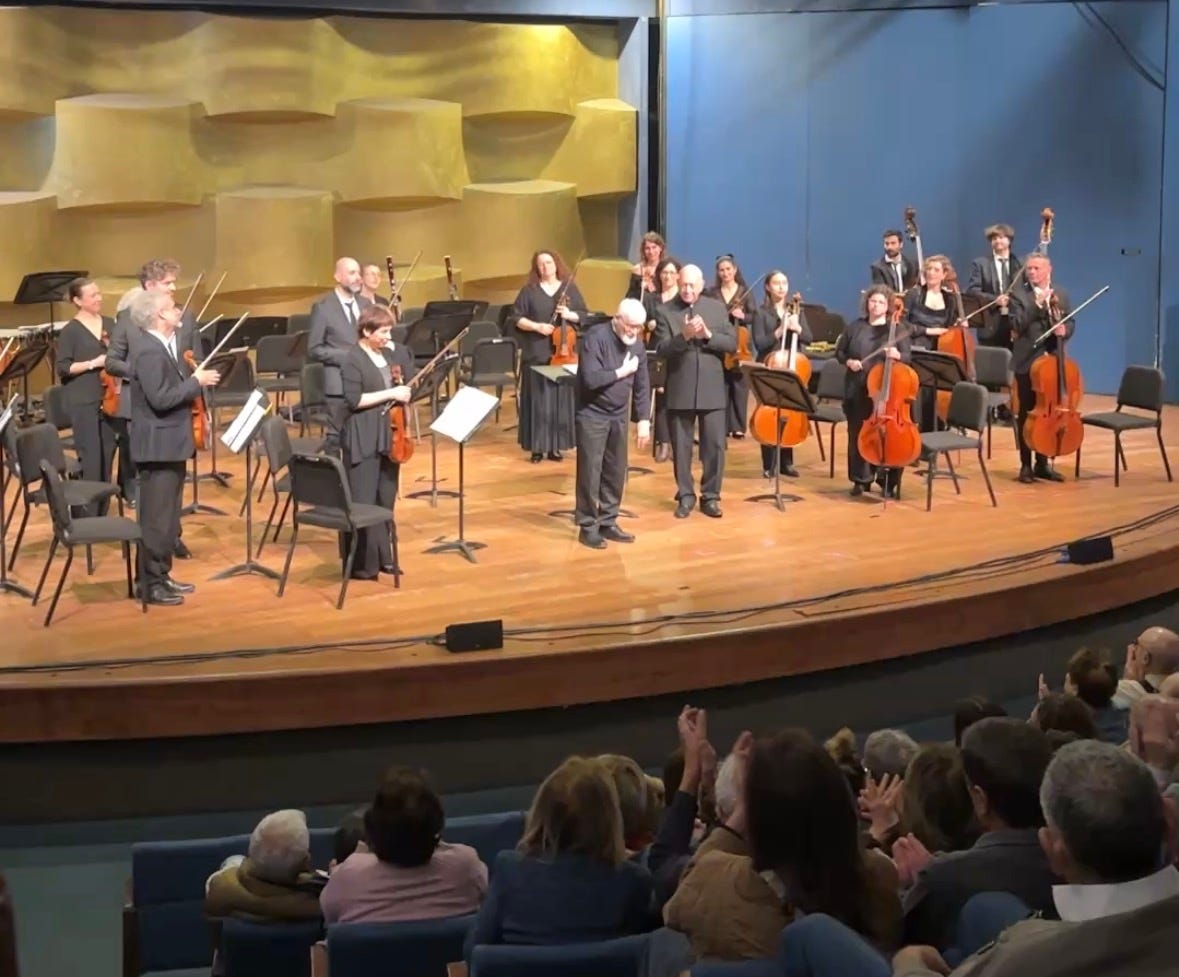
This morning's concert with the Israel Camerata Jerusalem Orchestra at the Tel Aviv Museum deepened a conviction I've been developing: that attending live performances is one of the best non-work things I can do with my time. I arrived with modest expectations. I've never been to these smaller chamber-orchestra concerts and assumed they'd feel like a reduced version of the 'real thing.' What I got instead was something far richer: not just beautiful music, but proof of why showing up to live art matters so deeply.
The setting was quite refreshing: You arrive for a concert while the museum itself is alive, people moving between exhibitions, culture happening in parallel rather than in a sealed-off temple. During the intermission, I went out to the sculpture garden, where there’s a café, daylight, sculpture, and coffee. Music felt embedded in a broader life of art, not isolated from it. I found that deeply enjoyable.
The concert opened with Mendelssohn’s Hebrides Overture, and it was a very smart choice. It immediately captured the audience. It’s one of those pieces that simply works, beautiful, transparent, inevitable. I even heard an elderly woman near me say out loud at the end, “What a beautiful work.” That told you everything. Opening with Mendelssohn wasn’t just musically satisfying; it was dramaturgically intelligent. Had they opened with Schumann instead, the hall would have felt heavier from the start.
Only then came Schumann’s Overture, Scherzo and Finale, performed here as an Israeli premiere nearly 180 years after the work was written. Being present at such a premiere is, in itself, an honour and a rare treat.
Placed after Mendelssohn, Schumann revealed a very different musical temperament. Where Mendelssohn feels effortless and immediately graspable, Schumann asks more of the listener. The music is denser, more inward, more restless. It does not present itself with the same ease, and that difference was instructive to hear. Rather than diminishing the experience, the contrast sharpened it. You could feel how thoughtfully the program had been constructed, not only to please, but to provoke listening.
In that sense, the Schumann worked exactly as it should have. It opened a different emotional and structural space in the hall, preparing the ground for what followed, and it was genuinely interesting to encounter it in this context, as part of a living musical conversation rather than as a familiar repertory staple.
After the intermission, the Israeli piece was Yizkor by Aharon Harlap. It stood out immediately. It was incredibly beautiful, romantic in spirit, emotionally direct, no modern nonsense, and very short. It said what it needed to say and stopped. It was also beautifully performed.
The composer himself was there, sitting in the audience with his wife. Watching him walk onto the stage and seeing the audience respond to him was deeply moving. There is something profoundly beautiful about seeing a living composer hear his work performed by a serious orchestra, placed alongside Mendelssohn and Schumann. What an honourable place to be. What joy that must be.
What struck me even more was that several young people approached him to thank him before I did. There was a real, spontaneous reception to the piece. This wasn’t polite appreciation; it was genuine recognition. Seeing young listeners walk up to a composer born in 1941 was very powerful to watch. It felt like a real moment of transmission, something being passed on.
The audience was genuinely overjoyed. They clapped strongly and warmly. And after the piece ended, there was silence, real silence. You could feel that it had hit them. That kind of silence after an emotionally powerful performance is not easy to achieve, either in writing the music or in executing it. It truly landed. And it’s something you never get from a recording.
I approached Mr Harlap afterwards and thanked him deeply. I was glad to hear that he is actively composing, and it made me very curious to hear more of his work. I left feeling grateful to have discovered him this way, and I can wholeheartedly recommend exploring his music further, particularly his Requiem and Bassoon Concerto.
The concert ended with Schumann’s Piano Concerto, one of my all-time favourites. The soloist, Alon Kariv, was only 25 and brilliant. His playing was mature, emotional, strong, powerful, not showy, not a young pianist trying to prove something, but a real kinship with the music. The wonderful conductor, Doron Salomon, was visibly joyful, and it was a pleasure to watch him interact with the soloist, letting him shine. That joy carried the whole hall.
I think what all of this ultimately comes down to is very simple: you have to go to live performances. Even when the program is not your favourite. Even when it is not something you were longing for or circling on your calendar. There is an opportunity in almost every concert, especially when it is played by a serious orchestra. If the program is thoughtful and the performers are committed, something usually happens.
I did not come to this concert because Schumann’s Overture, Scherzo and Finale is a personal favourite. What drew me was the Piano Concerto, and yet the entire morning turned out to be a wonderful surprise. The location, the programming, the living composer, the audience reaction, and the conversations afterwards. None of that could have been anticipated in advance.
That is exactly the point. Live music creates conditions for things you did not plan for. It places you in situations where something unexpected can enter. You cannot get that from recordings, nor can you get it by only chasing your personal canon.
So I encourage people to do this. Go to these concerts. Spend a Friday morning like this. Spend your weekends and evenings engaging with high art, even when it is not perfectly tailored to your taste. More often than not, it will reward you in ways you did not expect.
Thank you, Camerata Jerusalem!
If you enjoyed Philosophy: I Need It, and want to see more, you can support my work by buying me a coffee. Every contribution makes a real difference. Thank you!
And thank you for relating this experience. It was as if I was there too!
https://substack.com/home/post/p-185533850